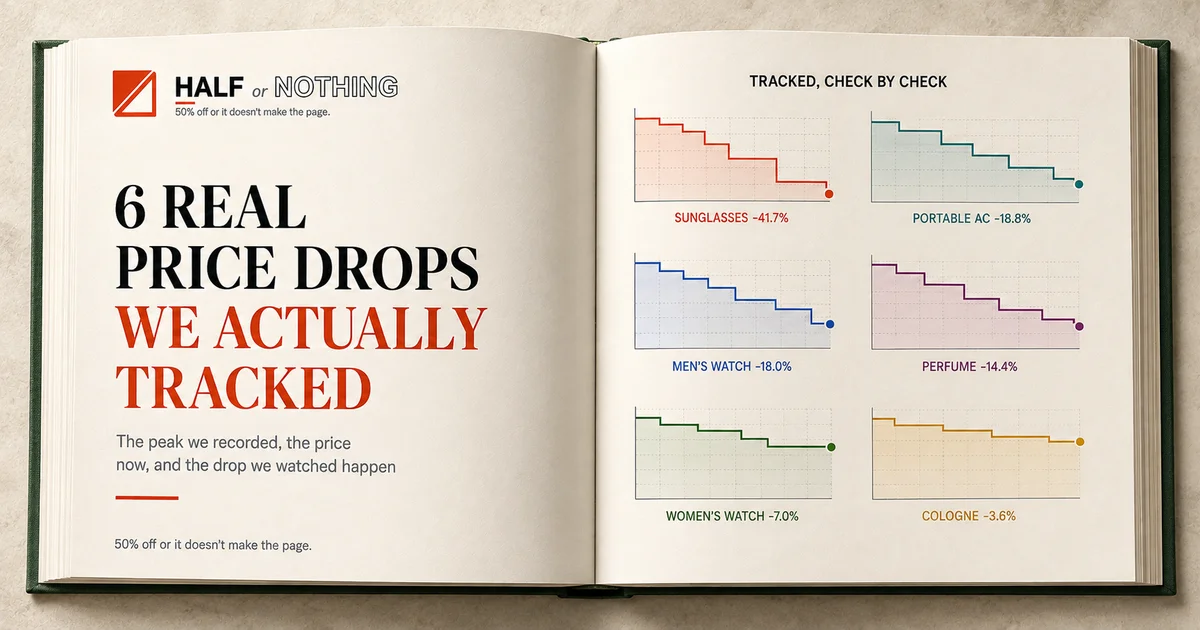
6 Real Price Drops We Actually Tracked
Six listings where our own price history shows the price genuinely moved, with the real drop we measured next to the discount the seller claims.
2026-08-24
Half or Nothing
50% off or it doesn't make the page.
2026-08-24 · Written by Checarlos Cruz · 4 min read
Every card on this site shows a discount percentage. Most of the time, that number comes straight from the seller: this is what they say the item used to cost, this is what it costs now, do the math. I don't independently verify the “used to cost” part for every listing, because I can't. Nobody selling secondhand or overstock inventory publishes a receipt.
What I can do is watch. Every time this site rescans a listing, and it rescans thousands of them every hour, it logs the price it sees. Over weeks, that turns into a real history: not what the seller claims the item used to cost, but what it has actually cost every time we checked.
Most of the time those two numbers roughly line up. Sometimes they don't, and that gap is worth talking about honestly instead of pretending it doesn't exist.
I went looking for the biggest gaps between a claimed discount and what our own tracking actually shows. One category kept coming up: designer sunglasses. A handful of listings claim discounts in the 80-87% range against “original” prices somewhere between $280 and $450. Real brands, real listings, nothing fake about the products themselves.
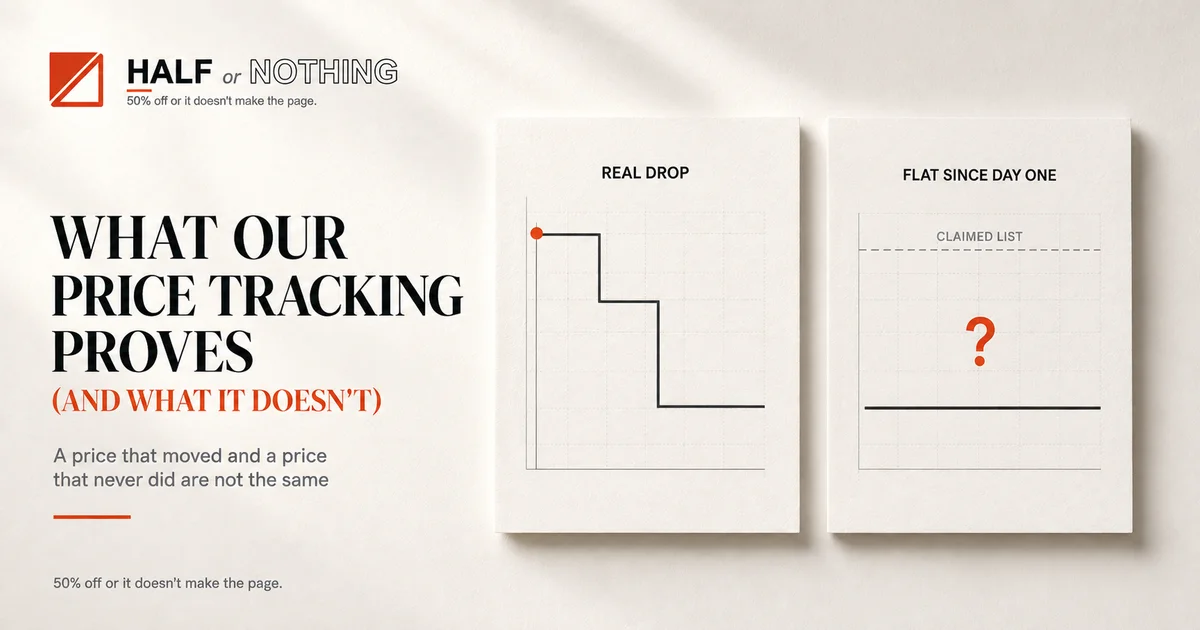
But when I pulled up our own tracked history for those same listings, going back to when we first saw them, the price hadn't moved. Not “dropped once and stayed low.” Not moved at all, within a dollar or two, across weeks of rescans. One item we've watched since August 12th has priced within about forty cents of itself on every single check since.
It does not mean the seller is lying. Designer eyewear liquidation legitimately works like this, all the time: a real MSRP that almost nobody ever actually paid, sitting way above the real, stable street price the item has always sold at. An 86% off badge against a number like that isn't necessarily fabricated. It just isn't describing a price drop. It's describing a gap between a list price and a sale price that, as far as we've seen, may have never changed.
What it does mean is that our own “real drop” number, the one built specifically to catch inflated “original price” claims, can't vouch for this kind of listing either way. It only knows what it's watched happen. If a price has been flat since the day we found it, we have no evidence it ever moved, in either direction. We're not confirming the discount is fake. We're saying we can't confirm it's real, and there's a real difference between those two sentences.
Because “fixing it” isn't actually possible without lying about what we know. I could hide the discount badge on listings like this, but that would just trade one kind of dishonesty for another, since I genuinely don't know if the discount is real or not. What I can do is tell you the truth: on a static-priced listing, the kind of tracked “real drop” you'll see on other cards, earned by an item actually falling from a documented peak, isn't something we can show you here. Treat those two differently. A number with weeks of real movement behind it and a number that has never moved mean different things, even when eBay's own percentage looks identical on both.
This is the same reason Amazon Picks on this site don't show a price at all. When I can't verify a number honestly, the answer isn't to publish it anyway and hope nobody checks. It's to say so, the same standard behind what counts as a real 50% off everywhere else on this site.
No. It means the tracking can't confirm the discount either way. If a price hasn't moved since we first saw it, that's not evidence the discount is fake, it's just evidence we have no data showing it ever moved, in either direction.
One item we've watched since August 12th has priced within about forty cents of itself on every single check since. Designer eyewear liquidation legitimately works this way: a real MSRP that almost nobody ever paid, sitting above a stable street price that itself never changes.
Because that would trade one kind of dishonesty for another. We genuinely don't know if the discount is real or not on a flat-priced listing, so the answer is to say so, not to publish the number anyway or quietly remove it.
Same standard. When a number can't be verified honestly, we say so instead of publishing it and hoping nobody checks.
For the six listings where our tracking did confirm a real, moving price, see 6 real price drops we actually tracked.
Every pick we've pulled at 50% off or more, in one place.
Visit our Amazon store ›Six listings where our own price history shows the price genuinely moved, with the real drop we measured next to the discount the seller claims.
2026-08-24
The difference between signal and noise in deal aggregation, and why Half or Nothing runs on data instead of urgency banners.
2026-08-30
The five-step pipeline behind every listing on Half or Nothing, refreshed every sixty minutes, and why Amazon is the one part of it I still do by hand.
2026-08-30