How Our Hourly Deal Refresh Actually Works
The five-step pipeline behind every listing on Half or Nothing, refreshed every sixty minutes, and why Amazon is the one part of it I still do by hand.
2026-08-30
Half or Nothing
50% off or it doesn't make the page.
2026-08-30 · Written by Checarlos Cruz · 8 min read
Most deal sites optimize for clicks, not accuracy, and it shows: expired codes, fake “original” prices, layouts built for ad impressions instead of actually helping you buy something worth buying. A deal aggregator site that's actually useful has to work more like a filter than a billboard.
I've run sites the loud way before, badges, timers, the works, and Half or Nothing is the version I'd actually want to shop on myself: hourly refreshes, a hard 50% cutoff, and no interface tricks doing the persuading for me.
In This Article
A deal aggregator's job is to cut down how much time you spend hunting for something worth buying. Raw marketplace feeds are chaotic, thousands of listings that don't matter to you. Good aggregation strips that down to what does. Some sites, like Slickdeals, lean on community voting for this. That works, but it's subjective. I'd rather the number do the deciding.
Signal is a verified price drop where the math is solid. Noise is everything else: “limited time” banners that never actually end, original prices nobody ever really charged. A disciplined aggregator throws the noise out and keeps the signal.
It pulls listings from Amazon and eBay, the two sources with the most price-drop density, into one feed with one consistent layout. You shouldn't have to learn a different UI for every retailer, and you shouldn't have to keep ten tabs open to compare. Only listings that clear a real quality bar make it in.
Pricing on these platforms moves algorithmically now, a manual search only ever catches a single moment, not the trend. An aggregator watches continuously instead. And search results themselves are a trap: the top results for “best deals” are often affiliate-heavy content built to rank, not to actually save you money. A real aggregator skips that layer entirely and goes straight at the price data.
Curation here is binary: a listing either clears the bar or it gets removed, nothing sits around half-verified. Expired listings get pulled immediately, which lines up with what the FTC expects from online sellers anyway, an advertised price should match reality.
Amazon and eBay push out more price changes in a day than any one person could track by hand, so this has to be automated at the base layer. But that doesn't mean it's hands-off: I go through the eBay feed myself before anything ships, and every single Amazon Pick is added by hand, because there's no automated feed there at all.
A list published yesterday is a list full of dead links today, that's just how fast Amazon and eBay inventory actually moves. Refreshing every hour keeps the site matched to real stock instead of guessing. You can watch this happen directly on the hourly refresh.
Generic coupon databases run on user-submitted codes that fail at checkout more often than not, that's the honest failure rate of crowdsourced codes. Curation here works differently: on eBay, the discount is always already baked into the price, no code needed, full stop. On Amazon it's a little different, some real deals do involve a clip-or-enter coupon, and when that's the case I find it, verify it, and add it myself instead of trusting a scraper. Either way, the target is the same: real discounts, usually 50% or deeper, checked by hand.
They're the two biggest sources of price-drop data, but they don't behave the same way, so they don't get the same process. Even after a discount clears, a bad rating on the product still gets it dropped, an automated system can catch a price drop, but it can't judge product quality on its own.
Pricing here shifts constantly with demand and inventory, most of that movement is noise and gets filtered out, what's left is a real deviation from the 90-day average, weighted toward sellers with a real track record. Amazon locks automated tools out on purpose, which is exactly why this is the one category where I'm doing the legwork myself, item by item, instead of letting a script handle it.
Open-box and refurbished categories on eBay tend to carry the deepest real discounts, better than standard used listings. I filter for “Buy It Now” only and skip auction-format listings entirely, since an auction price isn't a real price until it closes. The bar is the same 50% or higher either way.
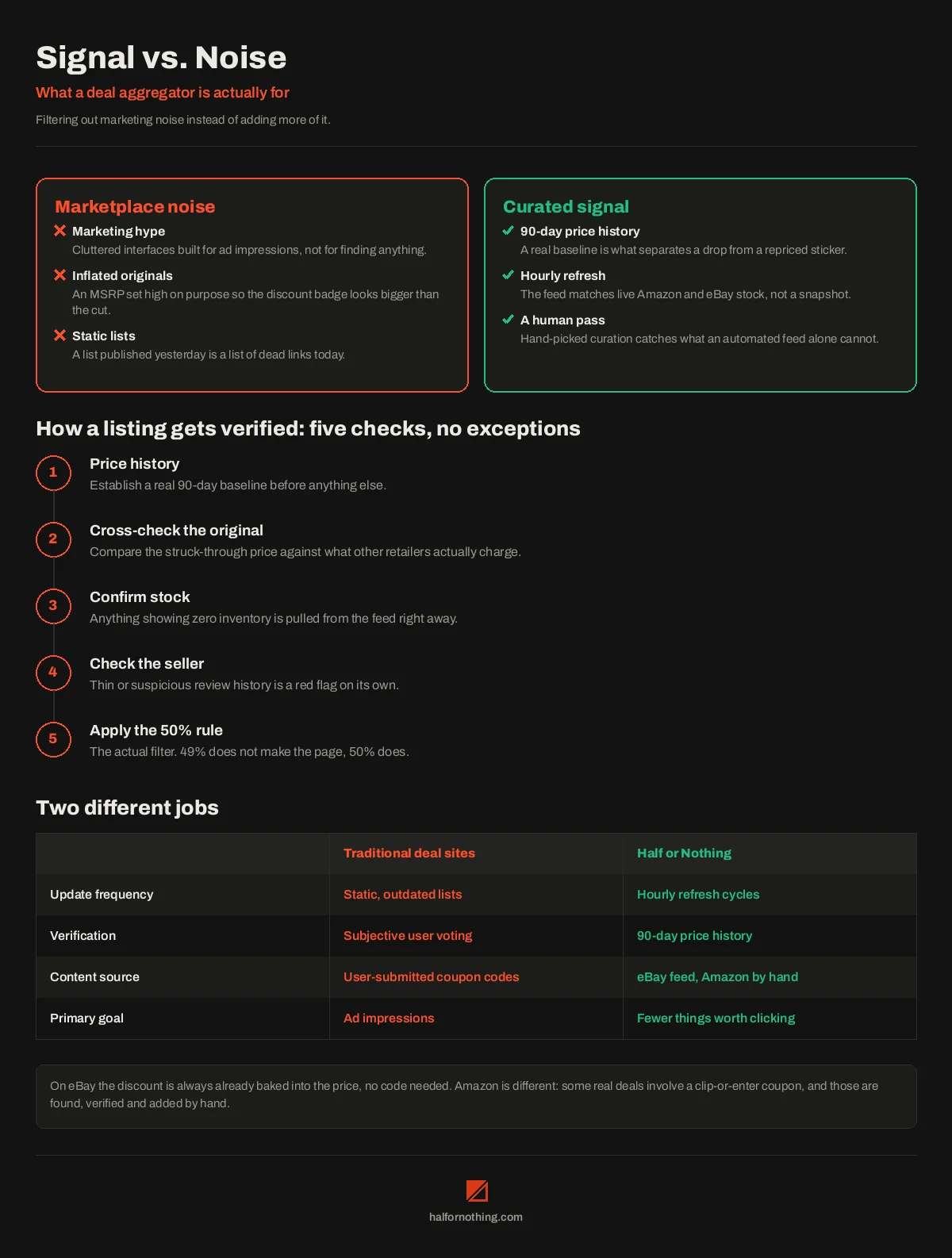
Five checks, every listing, no exceptions:
MSRP gets set artificially high all the time, specifically to make a discount look bigger than it is. The real number worth trusting is the actual average selling price, not the sticker. If something usually sells for $80 but carries a $120 MSRP, a “sale” price of $90 isn't a deal, it's a price hike wearing a discount badge.
A 10% drop is just normal retail noise, it happens constantly and means nothing. A 50% cut usually means real inventory clearance or genuine price competition, which is where the actual value is. It's a hard line: 49% doesn't make the page, 50% does. People ask why the site doesn't list more items, and the honest answer is I'd rather show fewer things worth clicking than pad the count with 20% off nothing.
Good discovery should feel calm, a clean scan through data that's already been checked, not a countdown clock trying to rush your decision. Most sites lean on urgency because urgency drives clicks. A reliable aggregator does the opposite: it just shows you the number and lets you decide.
“12 people viewing this right now” banners exist to short-circuit your judgment, not to inform it. A minimal interface with real pricing and real percentages doesn't need a “hot” badge, the number already tells you what you need to know.
The Half or Nothing feed refreshes hourly specifically so new inventory shows up while it's still available, not after it's gone. Checking in regularly is genuinely the best way to catch something before it sells out.
A deal aggregator curates real, live price drops. A coupon site hands out codes that fail at checkout more often than they work. I don't run a generic coupon database, on eBay the discount is already baked into the listing, and on Amazon, when a real coupon exists, I verify it and add it myself as part of a hand-checked listing, not a scraped code dumped into a database.
This one updates every hour, which is what it actually takes to stay accurate in high-turnover categories like electronics. A list that only updates daily is stale within minutes once stock starts moving.
They're checked against 90-day price history before anything gets published, that's the whole point of the process. Plenty of sellers inflate the MSRP to fake a bigger discount, and that check is specifically built to catch it.
Because inventory is genuinely finite, and a deep discount (50%+) moves fast once people find it. Once stock hits zero, the listing gets pulled on the next refresh.
No, and it can't really, shipping varies too much by location and by things like Amazon Prime membership to standardize. Always check the real total at checkout before you commit.
Look at how varied the feed actually is. A biased aggregator keeps pushing the same few brands regardless of how they're actually performing on price. This one follows the discount, if something clears 50% and passes the quality checks, it's in, there's no paid placement happening behind that.
Curated tends to be more consistent, community voting is honest but it's still opinion, and opinion drifts with brand sentiment more than it tracks real value. A disciplined filter doesn't have that problem.
Yes, and they're often some of the best discounts on the site, especially in electronics, since that inventory is usually offloaded fast to free up warehouse space. Everything still has to clear the same bar, including “Buy It Now” availability.
Every pick we've pulled at 50% off or more, in one place.
Visit our Amazon store ›The five-step pipeline behind every listing on Half or Nothing, refreshed every sixty minutes, and why Amazon is the one part of it I still do by hand.
2026-08-30
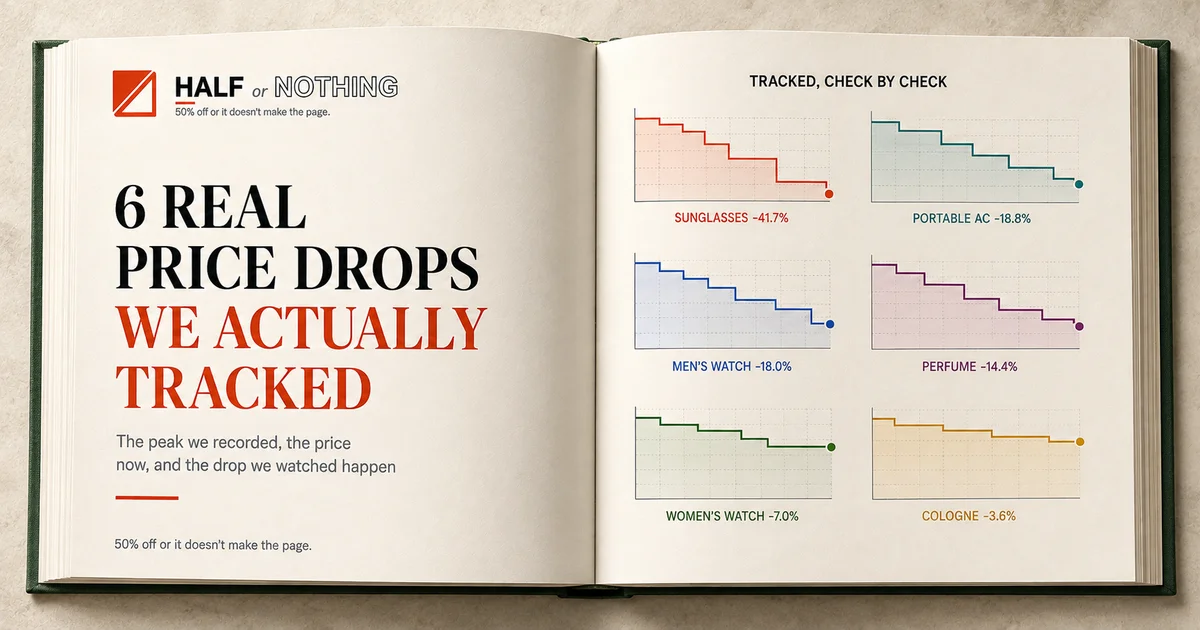
Six listings where our own price history shows the price genuinely moved, with the real drop we measured next to the discount the seller claims.
2026-08-24
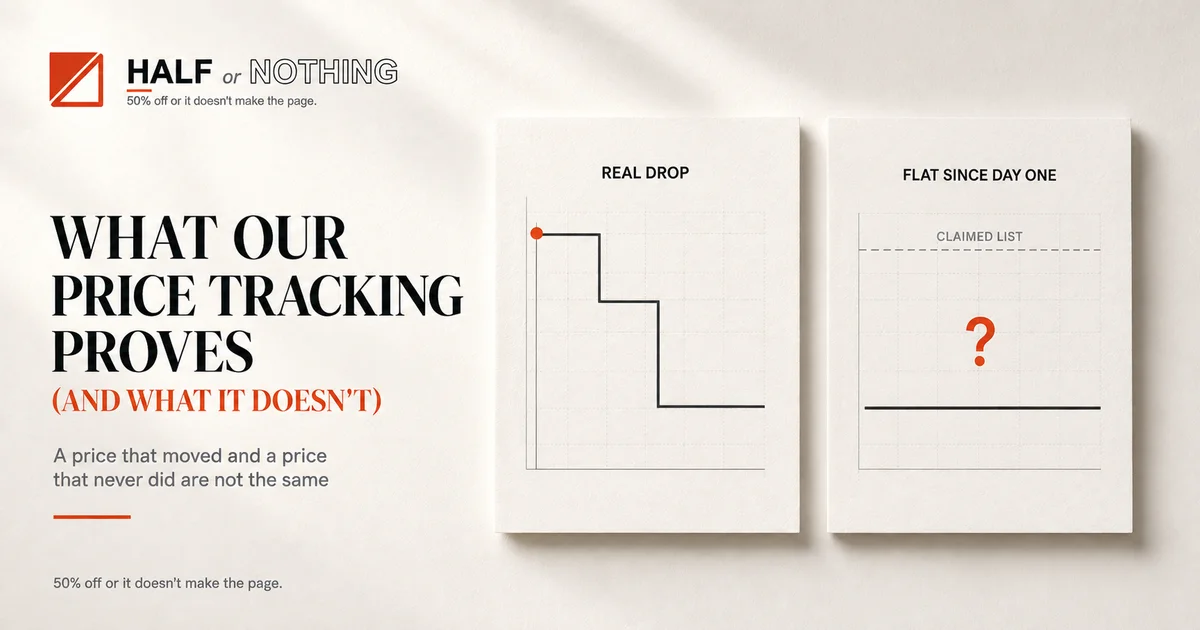
A real pattern our own price history can't verify one way or the other, and why I'm telling you instead of quietly hiding it.
2026-08-24