How a Deal Aggregator Site Actually Works
The difference between signal and noise in deal aggregation, and why Half or Nothing runs on data instead of urgency banners.
2026-08-30
Half or Nothing
50% off or it doesn't make the page.
2026-08-30 · Written by Checarlos Cruz · 10 min read
I built Half or Nothing after living the same frustration one too many times: clicking a link, finding the “original” price was inflated, or watching the stock disappear before I could even check out. A two-dollar markdown dressed up with a fake strikethrough price isn't a deal, it's just marketing, and most manual tracking and “big sale” feeds are built to sell you that feeling instead of an actual discount.
This post is the honest version of how the site actually stays current: what refreshes, how often, where I still do things by hand, and why.
In This Article
Deal decay is just the gap between a price drop happening and the stock running out. In categories like electronics and home goods, that gap is short, sometimes just a few hours for a real 50% cut on something popular. The deeper the discount, the faster it goes. A list that only updates once a day can't keep up with that, which is exactly why this one refreshes hourly instead.
Amazon and eBay both run dynamic pricing, prices shift with demand and inventory in ways that aren't always visible from outside. Flash sales and clearance windows can open and close fast, and if nothing's watching closely, the information is stale before you ever see it.
Anything updated by hand once a day or once a week runs into the same three problems constantly:
A lot of “best deals” roundups you'll find in search results are weeks old, ranking for SEO, not reflecting what's actually available right now. Curation has to be a continuous check, not something done once and left alone. Refreshing hourly is what actually closes that gap, and it's why I don't trust a “set it and forget it” list, including my own, if it isn't rechecking constantly.
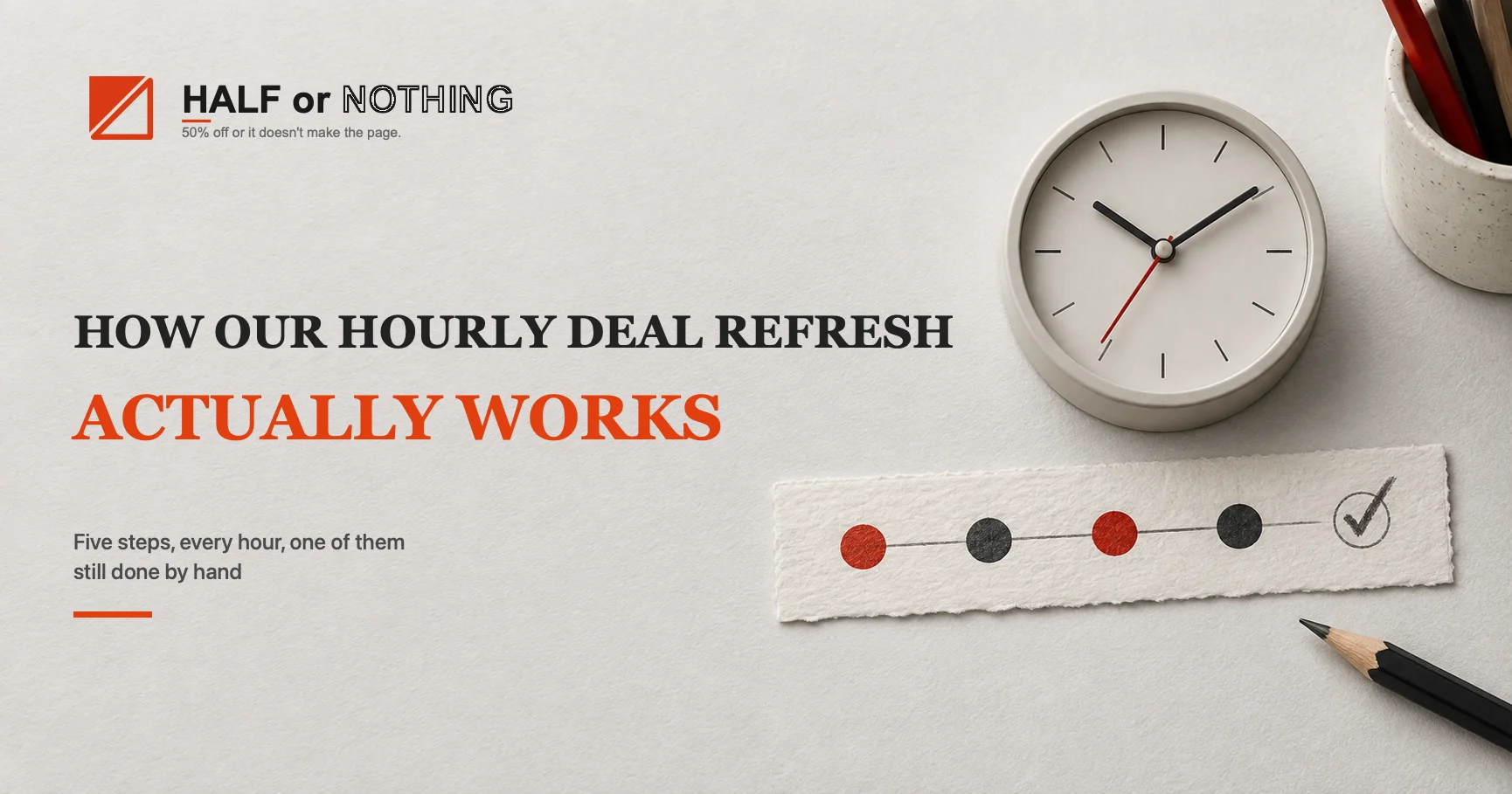
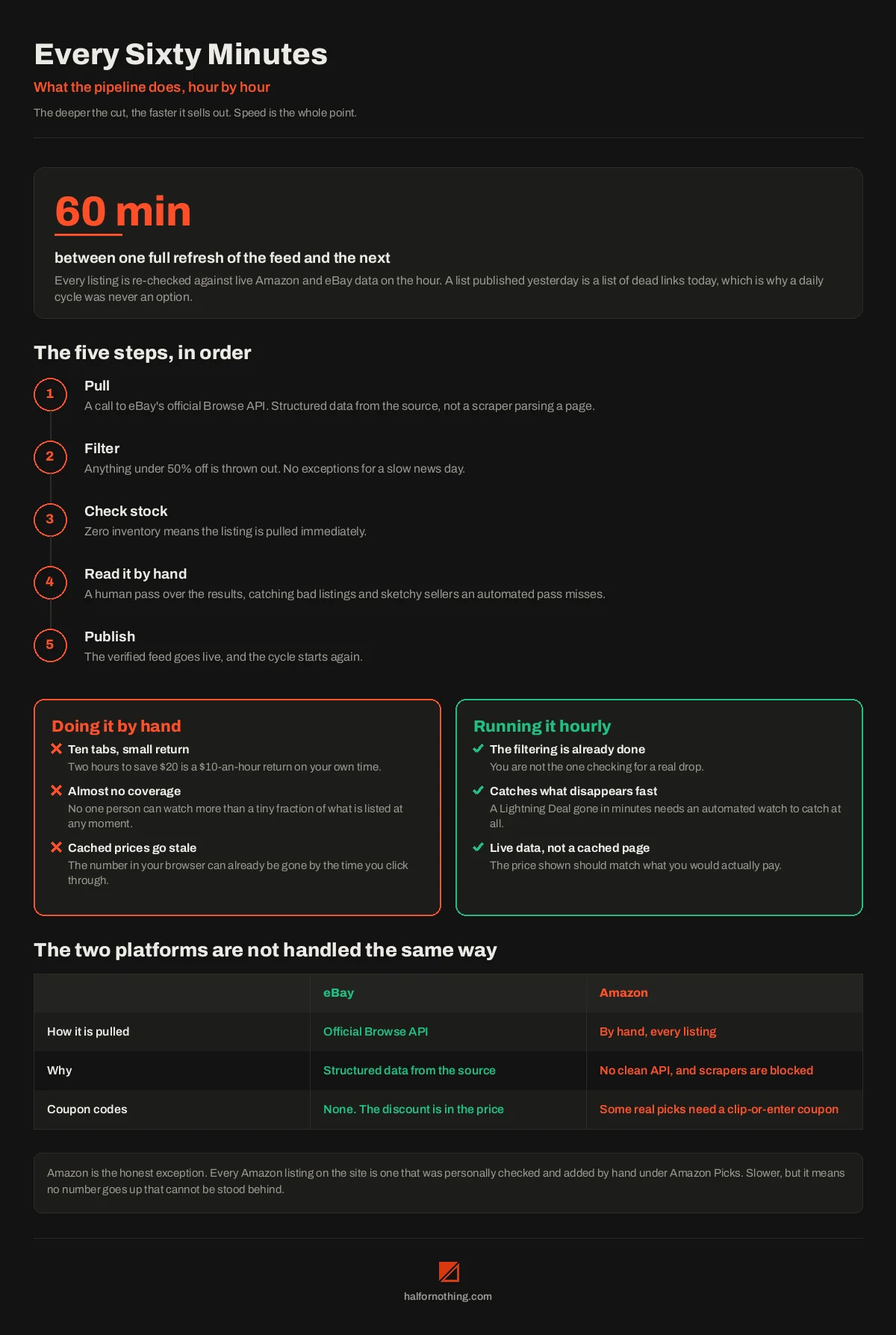
It's five steps, and speed is the whole point. It starts with a call to eBay's official Browse API, real structured data straight from the source, not a script trying to parse a web page and breaking every time the layout changes.
I'll be straight about the one part that isn't automated: Amazon doesn't give small operators clean API access to live pricing, and the site actively blocks scrapers, so I'm not going to pretend otherwise. Every Amazon listing on this site is something I personally checked and added by hand under Amazon Picks. It's slower, but it means I'm never showing you a number I can't stand behind.
From there: step two throws out anything under 50% off, no exceptions. Step three checks real stock, zero inventory means the listing gets pulled immediately. Step four is me, going through the results by hand to catch bad listings or sketchy sellers an automated pass would miss. Step five pushes the verified feed live, and the whole cycle repeats every sixty minutes.
Scraping breaks the moment a site's layout changes, an API doesn't. Pulling structured data directly from eBay means the price you see here actually matches what you'd see at checkout, with minimal lag. If the data doesn't check out, the listing gets removed, that part isn't negotiable. You can watch this in action on the hourly refresh itself.
Some sellers inflate the “original” price specifically to manufacture a bigger-looking discount. The filtering here checks historical pricing to catch that pattern, and leans toward categories like electronics and home goods where stock actually turns over fast enough for this to matter. It's still built to ignore “limited time” pressure entirely, that kind of banner isn't data, it's just noise.
By the time a listing reaches you, it's already been through automated filtering and a real human pass. On eBay, the discount's always already baked into the price, no code needed. Amazon's different: some picks genuinely do involve a real clip-or-enter coupon, and when that's true, I catch it (often through a tool like Koupon.ai), verify it, and add it by hand rather than importing it blind from a database.
Ten browser tabs open, comparing prices by hand, is a real time sink for very little return. An aggregator does that same watching automatically, across way more listings than one person could reasonably track.
If it takes two hours to save $20, that's a $10-an-hour return on your own time, which for most people isn't worth it. Pulling eBay and Amazon into one feed removes that math entirely, you're not the one filtering for quality or checking for a real drop, that's already been done before you show up.
Coverage matters too. No single person can watch more than a tiny fraction of what's actually listed on Amazon or eBay at any given moment. That's specifically why something like a Lightning Deal, gone in minutes once it's found, needs an automated watch to catch reliably. The priority here stays the same either way: 50% or better, and actually in stock, over anything paid to be seen.
A cached price in your browser can show you a number that's already gone stale, you click through and the real price is different at checkout. That's a real, common failure of doing this by hand. Pulling live data instead of a cached page avoids it, the price shown here should match what you'd actually pay. Hand-picked judgment still matters, especially for Amazon, but it has to be paired with a system actually checking the numbers, a purely manual list goes stale the moment it's published.
Pricing on these platforms isn't static, and understanding roughly when clearance happens helps. Big holidays bring a lot of marketing noise but often less real stock, off-peak windows tend to be better for genuinely deep cuts, since that's when retailers are actually clearing warehouse space rather than chasing holiday traffic.
I don't have a clean “best day” rule to hand you here, and I'd rather say that than make one up. What I can tell you: hourly refreshes are the only realistic way to catch a real price glitch or a short clearance window before it's gone, since those don't announce themselves in advance. You can catch these through the Amazon Picks and eBay feeds directly.
Open-box electronics and refurbished tools tend to move fastest, that inventory takes up real warehouse space retailers want back. Seasonal categories follow their own rhythm too, fashion and home/garden both tend to clear out ahead of a season change. Either way, the bar stays the same: a real, verified 50%+ off, checked against actual price history, not a guess.
Nothing under 50% off makes it onto Half or Nothing, that's not a suggestion, it's a hard line in the code itself. A lot of aggregators pad their numbers with smaller discounts to look more active. I'd rather show fewer things and have every one of them actually be worth your time. eBay listings never need a code, the discount's already in the price. Amazon coupons are the one exception: when a real one exists, I verify it myself and add it by hand instead of trusting a scraped feed.
I avoid words like “spectacular” or “insane” on purpose, they're marketing filler, not information. What you actually get on every card is price, discount percentage, and category, that's it. I'm not trying to talk you into anything, just show you the number and let you decide.
Amazon and eBay are the focus specifically because they're the two platforms with enough real data to make hourly checking worth doing. The site stays minimal for the same reason, less decoration means the actual numbers are easier to scan.
Every listing is tagged either “Amazon Pick” or “eBay Product” so you always know the source. Before clicking through, check the hourly timestamp, that's the last time the price and stock were confirmed. A recent timestamp means good odds the deal's still live. You can check today's live feed yourself to see this in action.
If a given hour just doesn't have great drops, the feed reflects that honestly instead of padding itself out, that's the whole difference between this and a site optimized for pageviews. And to be clear: affiliate commission never decides what makes the page or how it's ranked, sort order is by discount percentage, full stop, same as it's always been.
Catching real deep discounts reliably really does come down to checking often and refusing to trust an inflated baseline. Refreshing hourly is what closes the gap between a real price and a stale one.
The rule stays simple either way: nothing under 50% off, and no fake urgency dressing it up.
Every sixty minutes, pulling fresh data from eBay's Browse API 24 times a day. Daily or weekly batches aren't fast enough for how quickly real 50%+ deals move.
Because demand can outpace even an hourly cycle, a popular electronics deal can sell out in under fifteen minutes. Hourly refreshes shrink that gap a lot, but they can't stop real-time stock from running out between checks.
Usually not. On eBay, the discount's always already baked into the price. On Amazon, some listings do carry a real clip-or-on-page coupon, and when that's true it's already part of the listing, not something you need to go dig up separately. What you won't find here is a generic third-party coupon database, those are unreliable and often already expired by the time you get to them.
Not always, sellers do inflate them sometimes. That's exactly what the price-history check is for, if a baseline looks artificially high, the listing doesn't make the cut.
An aggregator tracks live marketplace data for real price drops. A coupon site hands out codes that fail at checkout more than they work. This isn't a coupon database, any real coupon gets verified and added by hand, and everything here reflects actual buyable inventory at the time it was checked.
Yes, that's one of the categories with the steepest real discounts, since retailers want that inventory off the shelf fast. Stock is usually limited to a single unit, so it moves quick.
Because it's a real line, not an arbitrary one. Plenty of sites count a 5-10% discount just to pad their numbers. I'd rather show you fewer deals that are actually worth your time than fill the page with markdowns nobody should bother with.
No, it's free. Half or Nothing runs on affiliate commission when you buy through a listing here, which is what keeps it free while staying focused on getting the price right. That commission never decides what makes the page, sort order is by discount percentage alone.
Every pick we've pulled at 50% off or more, in one place.
Visit our Amazon store ›The difference between signal and noise in deal aggregation, and why Half or Nothing runs on data instead of urgency banners.
2026-08-30
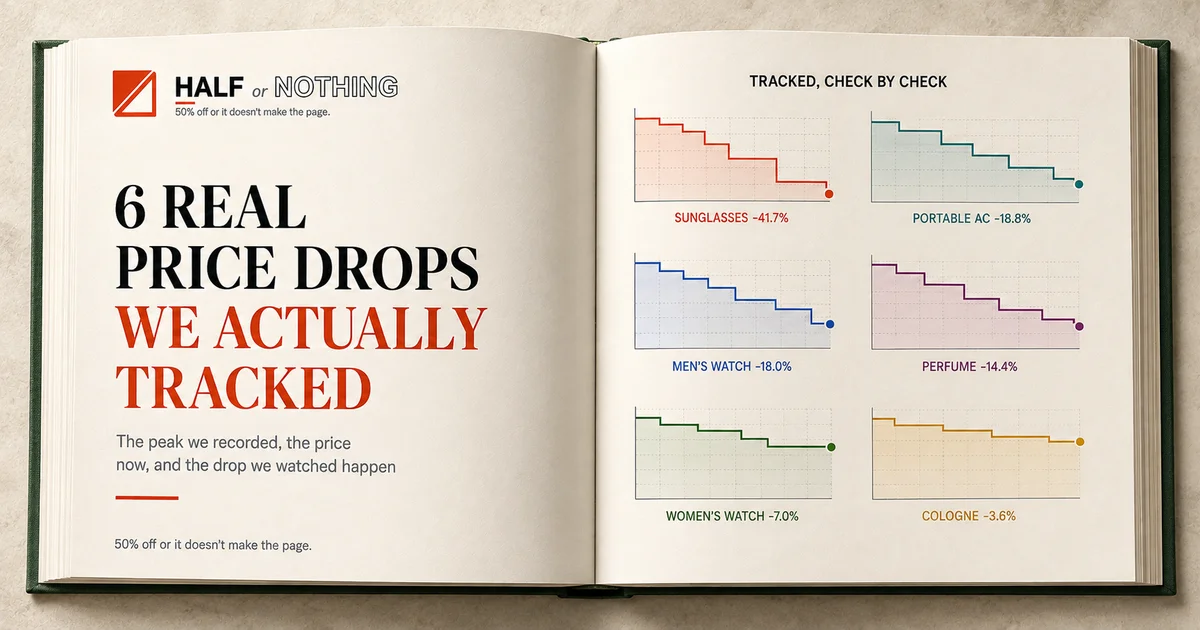
Six listings where our own price history shows the price genuinely moved, with the real drop we measured next to the discount the seller claims.
2026-08-24
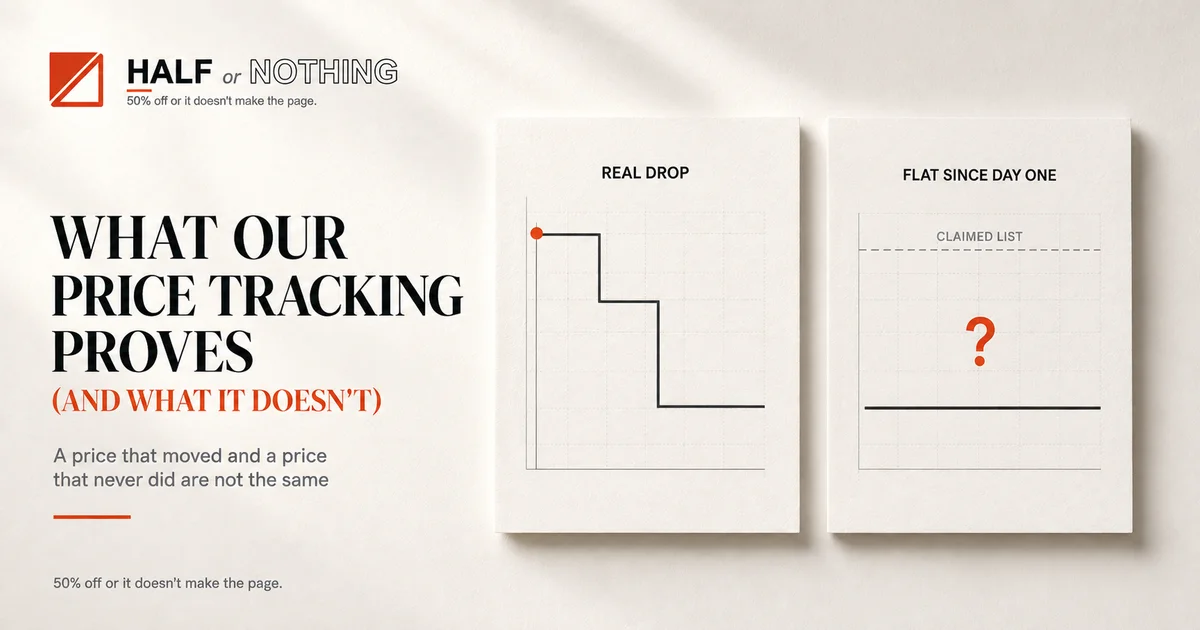
A real pattern our own price history can't verify one way or the other, and why I'm telling you instead of quietly hiding it.
2026-08-24