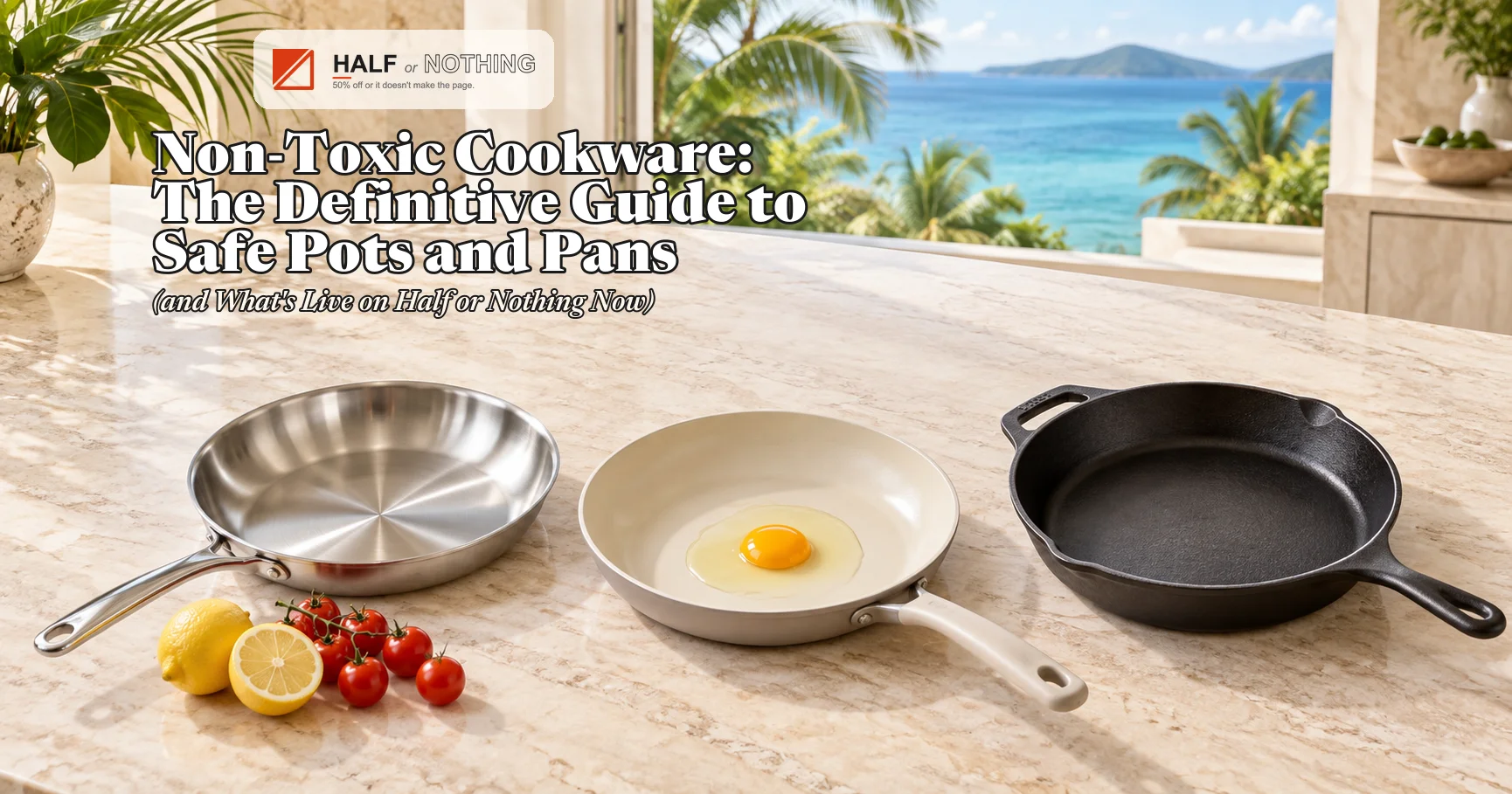
Non-Toxic Cookware: The Definitive Guide to Safe Pots and Pans (and What's Live on Half or Nothing Now)
2026-09-16 · Written by Dann Nazario · 20 min read
I've wanted to write this one for a long time. In fact, it's the kind of question my own family asks me more than almost anything else: what's actually safe to cook with, and what's just pure marketing?
I'd been putting this guide off because I didn't want to tell people what to buy without being sure it was actually worth it, or without having it available on our own platform. That felt empty.
Most of us never thought twice about the pan we cook eggs in every morning, until terms like "PFAS," "forever chemicals," and "polymer fume fever" started flooding the news. The medical science behind those headlines is completely real, but that doesn't mean you should panic or throw out your whole kitchen this weekend.
So I finally sat down and did the hard work: I researched the health studies, checked options across different places, and made sure our own inventory got checked properly too. This guide breaks down exactly what the real risk is with these materials, which ones are genuinely inert for your body, and which toxin-free cookware sets are live on Half or Nothing, pulled hourly like every deal on the site, at 50% off or more right now.
In This Article
Key Takeaways
Traditional non-stick coatings use PTFE, a member of the PFAS ("forever chemicals") family that doesn't break down in the body or the environment.
Overheating a Teflon-coated pan past roughly 500°F (260°C), or cooking on a scratched one, can release fumes linked to "polymer fume fever," a short-lived flu-like illness.
Bare aluminum reacts with acidic or salty food, transferring metal particles into what you're eating.
Five material families are considered genuinely safe: PFAS-free ceramic non-stick, clinical-grade stainless steel, cast iron and carbon steel, enameled cast iron, and 100% pure ceramic.
A 2026 California disclosure law now forces cookware brands to state publicly whether their products contain PFAS, and a free directory lets you check any brand's own claim.
If you can only choose one material for daily use, three-ply or five-ply stainless steel wins on safety, durability, and practicality combined.
You don't need to replace everything at once. Start with the one pan you use daily, usually the pan you cook eggs in.
What You Can Buy on Half or Nothing Right Now
Here's where the "clean cooking" upgrade gets real: real ceramic non-stick sets, verified live on Half or Nothing today, all clearing our real 50% off bar. These use a ceramic coating instead of a traditional PTFE non-stick finish, per each listing's own description.
A personal note from researching this: I'm going to be straight with you about where these land on the ranking further down in this guide. What we have live right now isn't the "Better" tier, it's the "Good" tier. These are real, PFAS-free ceramic sets, and I'd put one in my own kitchen without hesitation, but stainless steel is still the single best pick and none of it has hit our 50%+ bar yet. That's exactly why I kept the stainless, cast iron, and enameled cast iron names in the "Brands We're Watching" list right after these, so you know what to look for even while we don't have it. The moment a real deal on one shows up, it moves into this section.
Gotham Steel 20-Piece Nonstick Pots and Pans Set
Gotham Steel 20-Piece Nonstick Pots and Pans Set $61.00 (was $300.00, 80% off) The deepest discount in the category right now. A full 20-piece set covering pots, pans, and bakeware in one purchase. Shop it on Half or Nothing
Cuisinart Preferred Ceramic 4-Piece Cookware Set
Cuisinart Preferred Ceramic 4-Piece Cookware Set $35.00 (was $140.00, 75% off) The lowest price point on this list and the easiest way to test a ceramic set without committing to a full kitchen overhaul. Shop it on Half or Nothing
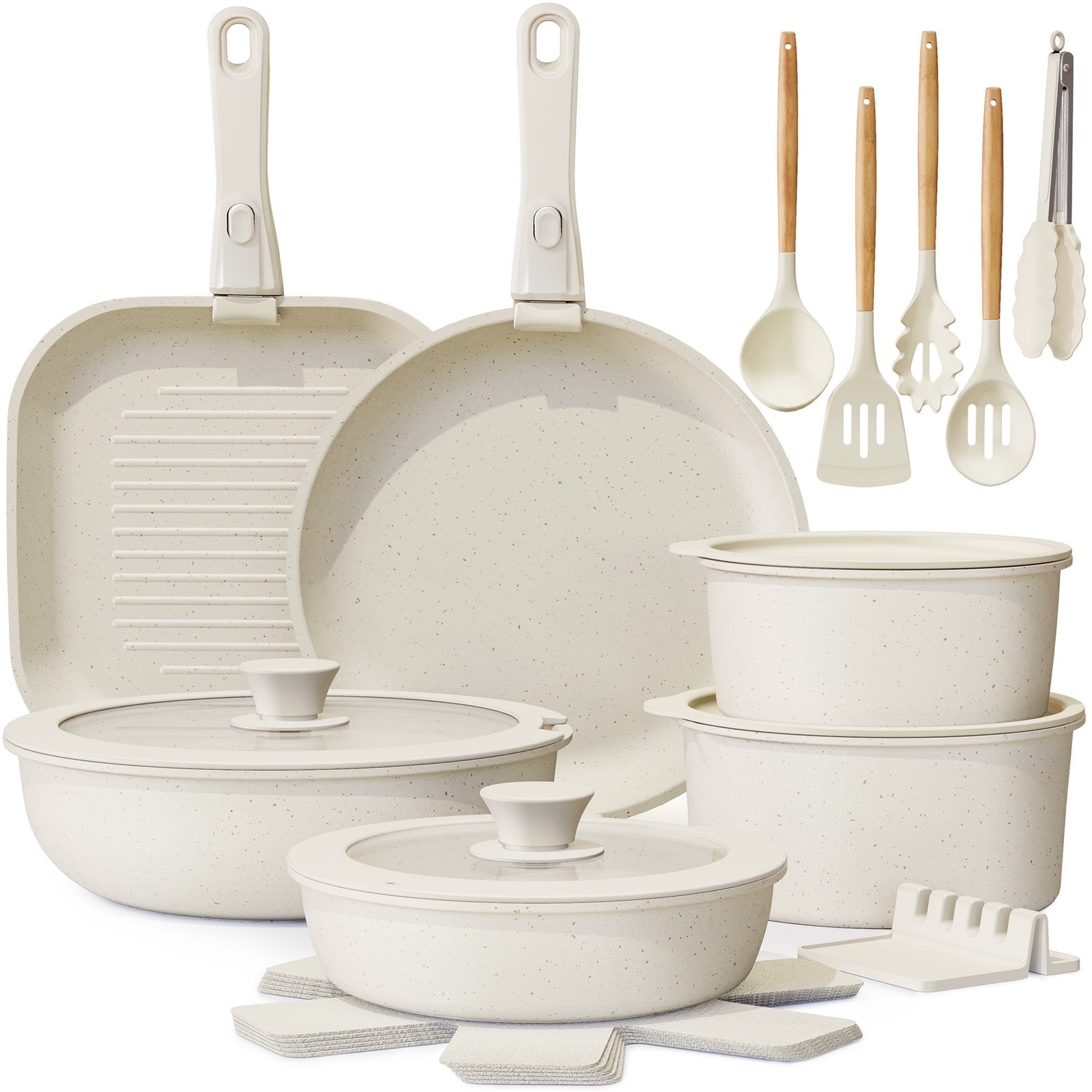
Carote 21-Piece Non-Stick Cookware Set, Beige
Carote 21-Piece Non-Stick Cookware Set (Beige) $82.00 (was $239.99, 66% off) Induction-compatible and one of the largest sets on this list at 21 pieces. Shop it on Half or Nothing
Blue Diamond Gold 14-Piece Ceramic Nonstick Cookware Set
Blue Diamond Gold 14-Piece Ceramic Nonstick Cookware Set $61.00 (was $164.99, 63% off) Diamond-infused ceramic coating, a brand built its entire reputation on going PFAS-free early. Shop it on Half or Nothing
Sensarte 17-Piece Ceramic Nonstick Pots and Pans Set
Sensarte 17-Piece Ceramic Nonstick Pots and Pans Set $36.00 (was $90.00, 60% off) A mid-size set that covers the daily essentials without the bulk of a 20-plus-piece collection. Shop it on Half or Nothing
T-fal Revive Ceramic 12-Piece Nonstick Cookware Set, Stone Gray
T-fal Revive Ceramic 12-Piece Nonstick Cookware Set (Stone Gray) $68.00 (was $169.99, 60% off) Built with T-fal's GoCeram ceramic coating, from a brand with decades in cookware manufacturing. Shop it on Half or Nothing
Sensarte 22-Piece Ceramic Nonstick Pots and Pans Set
Sensarte 22-Piece Ceramic Nonstick Pots and Pans Set $48.00 (was $114.99, 58% off) The larger of the two live Sensarte sets, with enough pieces to fully outfit a kitchen. Shop it on Half or Nothing
Astercook 22-Piece Ceramic Nonstick Cookware Set
Astercook 22-Piece Ceramic Nonstick Cookware Set $38.00 (was $80.00, 53% off) Detachable handles make this set easier to store for smaller kitchens. Shop it on Half or Nothing
Sensarte 18-Piece Nonstick Ceramic Pots and Pans Set, Gray
Sensarte 18-Piece Nonstick Ceramic Pots and Pans Set (Gray) $37.00 (was $74.99, 51% off) Detachable handles again, the lowest discount of the group but still clears our 50% bar. Shop it on Half or Nothing
A quick note on scope: these prices, discounts, and listings rotate hourly, exactly like the rest of the site (see how our hourly deal refresh actually works), and material claims above reflect each seller's own product description, since Half or Nothing does not independently lab-test coatings for PFAS content.
Brands We're Watching (Not at 50% Off Yet)
None of the names below are at our 50%+ discount yet, for two different reasons. Caraway and GreenPan are premium ceramic non-stick brands, the same material we already sell above from other manufacturers, just not these two specific ones at our discount. The rest (Made In, All-Clad, Lodge, Le Creuset) cover materials we don't have any listing for at all right now: stainless steel, cast iron, and enameled cast iron. Either way, there's no price or percentage listed, since none of it clears our bar today. We're tracking all seven and will move any of them up into the section above the moment a real 50%+ deal shows up.
Caraway 12-Piece Non-Stick Ceramic Cookware Set, a leading PFAS-free ceramic brand. View on Amazon. Not at our discount yet.
GreenPan Valencia Pro Ceramic Cookware Set, built with GreenPan's patented, diamond-reinforced Thermolon coating. View on Amazon. Not at our discount yet.
Made In 12-Inch Stainless Steel Frying Pan, 5-ply clad construction crafted in Italy. View on Amazon. Not at our discount yet.
All-Clad D3 Stainless Steel Fry Pan, made in the USA and built to last generations without metal leaching. View on Amazon. Not at our discount yet.
Lodge Pre-Seasoned Cast Iron Skillet, the most affordable, versatile entry point into cast iron. View on Amazon. Not at our discount yet.
Le Creuset Enameled Cast Iron Round Dutch Oven, the French benchmark for enameled cast iron, built for acidic sauces and long braises. View on Amazon. Not at our discount yet.
Lodge Enameled Cast Iron Dutch Oven, the same toxin-free enamel protection at a more accessible price point. View on Amazon. Not at our discount yet.
Why Your Cookware Actually Matters
The Problem With Traditional Non-Stick
Conventional non-stick pans are coated with PTFE (polytetrafluoroethylene), part of a much larger chemical family called PFAS, short for per- and polyfluoroalkyl substances. These are nicknamed "forever chemicals" because the carbon-fluorine bond that holds them together is one of the strongest in chemistry, so they don't break down in the environment or in the human body. According to the National Institute of Environmental Health Sciences (NIEHS), PFAS have been found in the blood of the vast majority of Americans tested, and ongoing exposure allows blood levels to build up over time.
The practical risk in the kitchen shows up in two ways:
Overheating. When a PTFE-coated pan is heated past roughly 500°F (260°C), it can release fumes associated with a short-term, flu-like illness sometimes called "polymer fume fever" or "Teflon flu." An empty non-stick pan left on a hot burner can cross that threshold in just a few minutes, faster than most people expect, which is why "preheating empty while you prep" is one of the most common ways this happens by accident.
Scratching. A scratched or worn non-stick surface exposes the coating and the metal underneath it more directly to heat and food, accelerating the release of both the coating's compounds and any reactive metal below it.
A practical way to avoid overheating without watching a thermometer: match the pan to the oil. Extra virgin olive oil starts to smoke around 375 to 410°F, refined coconut oil around 450°F, and avocado oil as high as 520°F. If your oil is smoking, your pan is already hotter than a non-stick coating should be.
The "Stone" or "Granite" Coating Myth
A lot of pans marketed as "stone," "granite," or "diamond" coated are not a different material at all. In most cases, the base coating is still PTFE (the same chemistry as traditional Teflon), reinforced with mineral particles and colored pigment so it looks and feels like stone. The name refers to the finish, not the chemistry underneath it. If a listing doesn't specifically say "ceramic" or "PFAS-free," treat a stone or granite label as marketing language for a traditional non-stick coating, not a different, safer category.
Reactive Metals
Bare or lower-grade aluminum and copper are the two metals to watch. Acidic ingredients like tomato sauce, citrus, or vinegar, and salty foods, can react directly with unlined aluminum or copper, transferring trace metal particles into the food itself and altering its flavor. This is why most reputable aluminum cookware is anodized, clad with another metal, or coated, rather than left bare, and why copper cookware is almost always lined with a layer of stainless steel or tin.
The Goal: Inert Materials
None of this means every pan in your kitchen is dangerous. The goal of "clean cooking" is simply to prioritize materials that are chemically inert or stable, meaning they don't alter the flavor of food or transfer synthetic compounds or reactive metals into it during normal cooking.
How PFAS Actually Affects the Body
PFAS aren't just a persistence problem, they're specifically classified as endocrine disruptors. The National Institute of Environmental Health Sciences (NIEHS) defines endocrine-disrupting chemicals as substances that can mimic, block, or interfere with the body's hormones, which regulate growth, metabolism, fertility, and reproduction in extremely small amounts, meaning even minor disruptions can have outsized effects. NIEHS lists PFAS by name among the well-studied endocrine disruptors, specifically citing nonstick pans as a source of exposure.
The Agency for Toxic Substances and Disease Registry (ATSDR), part of the CDC, maintains a formal review of PFAS health effects based on its 2021 Toxicological Profile. It found sufficient evidence of an association between PFAS exposure and higher cholesterol, small decreases in birth weight, and a lower antibody response to some childhood vaccines. Some individual studies also link PFAS to reproductive health and metabolic changes, though ATSDR is careful to note that evidence for effects like thyroid dysfunction is still limited or inconsistent rather than firmly established, so it's fair to say the science here is real but still evolving on some specific outcomes.
Pregnant Women and Young Children
ATSDR's own clinical guidance for health providers explicitly calls out "pregnancy, breastfeeding, and children" for extra attention when managing PFAS exposure. Two of the specific, evidence-backed effects, reduced vaccine response in children and small reductions in birth weight, land directly in that population. That's the practical reason this transition is worth prioritizing sooner rather than later in a household with a pregnant person or young kids, even though the everyday risk from a well-maintained pan is low.
What's Actually Changing in 2026
Cookware regulation moved faster in the last year than most people realize, and most of it is genuinely useful if you're shopping right now.
In October 2025, California Governor Gavin Newsom vetoed Senate Bill 682, which would have banned PFAS outright in cookware and several other household product categories statewide. That veto means there is no blanket PFAS ban on cookware sold in California, or anywhere else in the US, as of this writing. Colorado, Connecticut, and Minnesota have already banned PFAS in cookware at the state level, according to EWG, but most of the country, including California, has not.
What did pass is smaller but still useful: a separate California law regulating PFAS in food packaging also requires cookware manufacturers to disclose on their own websites whether their products contain PFAS, and that disclosure is public for shoppers in every state, not just California. The advocacy group Defend Our Health compiled those disclosures into a single public directory covering more than 200 cookware brands. Per EWG's review of that directory, about 40% of the 210 companies checked (82 brands) disclosed that their cookware does contain PFAS, 44 brands clearly disclosed that they do not, and another 23 made a PFAS-free claim that couldn't be independently verified through the required disclosure.
If you already own cookware, or you're eyeing a specific brand from the "Brands We're Watching" list earlier in this guide, Defend Our Health's cookware directory is the fastest way to check that brand's own disclosure directly, rather than relying on marketing language on the box. It's the same instinct behind how we verify a real online deal: check the actual source, not the marketing copy.
The Safe Materials, Explained
Clinical-Grade Stainless Steel (18/10 or 304)
Stainless steel is the standard in professional kitchens for a reason. It has no organic coating to wear off, handles any stovetop temperature, and can last for decades with basic care. The one caveat worth knowing: people with a severe nickel allergy should be cautious simmering highly acidic sauces in stainless steel for extended periods, since prolonged acidic cooking can draw out trace amounts of nickel.
Cast Iron and Carbon Steel
These are rustic, single-ingredient materials made only of iron and carbon. Instead of a factory-applied coating, they develop their own non-stick surface through "seasoning," a process of baking a thin layer of vegetable oil into the metal. The only thing they meaningfully leach is dietary iron, which is generally considered a benefit rather than a risk for most people. The tradeoff is weight and a small amount of ongoing maintenance to keep the seasoning intact.
Enameled Cast Iron
This combines the heat retention of cast iron with a protective, inert glass (vitreous enamel) coating fired onto the surface. Because the interior is glass rather than raw metal, it doesn't react with acidic ingredients, which makes it the material of choice for long-simmered tomato sauces, wine reductions, and braises. The main risk is chipping if the pot takes a hard impact.
100% Pure Ceramic
This is clay fired at extremely high temperatures with no metal core at all, making it arguably the most inert cooking surface that exists. It's ideal for slow, gentle cooking, though it isn't built for the same high-heat searing that stainless steel or cast iron handles easily.
Ceramic Non-Stick (Sol-Gel / "Liquid Glass")
This is the modern, PFAS-free alternative to Teflon. A metal base (usually aluminum) is coated with a gel derived from baked silica sand instead of a fluoropolymer. Done right, it's completely free of PFAS, PTFE, lead, and cadmium. The tradeoff is lifespan: the coating's non-stick performance typically wears down after 1 to 3 years of regular use, versus the decades you get from stainless or cast iron.
A newer hybrid worth knowing about is non-stick titanium, where a non-stick texture is worked directly into an inert titanium surface rather than coated on top of it, avoiding synthetic coatings entirely.
Material Safety at a Glance
Material
Safety Level
Main Advantage
Key Consideration
Ceramic Non-Stick (PFAS-Free)
High
Nothing sticks, easy cleanup
Coating performance fades in 1 to 3 years
Stainless Steel (18/10)
Excellent (inert)
Virtually indestructible, professional-grade
Takes practice to control heat without sticking
Cast Iron / Carbon Steel
Excellent (natural)
Great heat retention, adds dietary iron
Heavy, needs periodic seasoning
Enameled Cast Iron
Excellent (inert)
Best for acidic sauces and long braises
Enamel can chip from hard impacts
100% Pure Ceramic
Excellent (inert)
The most chemically inert surface available
Not built for high-heat searing
Best to Worst, at a Glance
Rank
Cookware
Verdict
Best
Stainless Steel (18/10 / 304)
No coating to ever wear off, virtually indestructible, and the best real-world balance of safety, durability, and everyday practicality.
Better
Enameled Cast Iron
Inert glass surface fired onto iron. Handles acidic sauces with zero reaction, but heavier and can chip.
Better
100% Pure Ceramic
No metal core, no synthetic coating, the most chemically inert surface that exists, but not built for high-heat searing.
Good
Cast Iron / Carbon Steel
Naturally seasoned, only leaches dietary iron, but heavy and needs ongoing upkeep.
Good
Ceramic Non-Stick (PFAS-Free)
Free of PFAS, PTFE, lead, and cadmium, but the coating wears out in 1 to 3 years.
Worst
Scratched or Overheated PTFE Non-Stick
Releases PFAS fumes above roughly 500°F (260°C) and exposes reactive metal once scratched.
Worst
Bare, Unlined Aluminum
Reacts directly with acidic or salty food, transferring metal particles into it.
If You Can Only Pick One: The Overall Winner
If you had to choose a single material to handle every meal in a real, everyday household, it's three-ply or five-ply stainless steel (also called tri-ply or multi-clad), the same material the table above already ranks first.
Why it wins:
Totally inert. No coating to peel, scratch, or end up in your food. It doesn't react with acidic ingredients like tomato sauce or lemon, so you can cook anything in it for hours without metal leaching.
Built to last decades, not years. Ceramic and non-stick coatings need replacing every 1 to 3 years once they lose their finish. A good stainless pan can outlast the kitchen it's in. It also shrugs off metal utensils and thermal shock far better than ceramic or enamel does.
Stove to oven, no compromise. Sear on the stovetop, then move the same pan straight into the oven to finish. It handles very high heat without warping or off-gassing anything.
Low maintenance. No seasoning ritual. Burnt-on food comes off with vinegar, baking soda, or a stainless cleaner, and it's dishwasher safe.
Why it beats the other finalists:
Versus ceramic non-stick: Ceramic is genuinely great for eggs and pancakes, but its non-stick performance fades within a couple of years, so you're back to buying another set. Stainless steel doesn't have that expiration date.
Versus pure cast iron: Cast iron holds heat beautifully, but it's heavy enough to be awkward for a lot of people to maneuver daily, it can't sit soaking in the sink without rusting, and it needs ongoing seasoning to stay in good shape.
The one trick stainless steel requires: it isn't naturally non-stick, so food will stick unless the pan is properly preheated first. The reliable test is the Leidenfrost effect: heat the empty pan over medium heat, then flick in a drop of water. If it skitters around the surface like a tiny bead of mercury instead of evaporating on contact, the pan is at the right temperature. Add your oil, and food won't stick.
Caring for Your Cookware
Even a genuinely safe material can be undermined by how it's treated. A few habits protect the investment and keep any of these materials performing the way they're supposed to.
Avoid thermal shock. Plunging a hot pan straight into cold water can crack ceramic and pure ceramic surfaces, or warp stainless and enameled cast iron over time. Let cookware cool on the stove or counter before it touches water.
Season cast iron and carbon steel with a high-smoke-point oil. Flaxseed oil and avocado oil both polymerize into a durable, natural non-stick layer when baked onto bare iron or carbon steel, which is what "seasoning" actually is chemically. A few thin coats, baked on, build a surface that improves with use.
Match your utensils to the surface. Metal spatulas and whisks are fine on stainless steel and well-seasoned cast iron, but they'll scratch ceramic non-stick and PTFE coatings almost immediately. Wood, bamboo, and food-grade (platinum-cured) silicone are the safe default on any coated surface.
Frequently Asked Questions
What does medical science actually say about the chemicals in non-stick cookware?
The National Institute of Environmental Health Sciences (NIEHS) classifies PFAS as chemicals of concern for their persistence in the body and the environment, and links to research on endocrine disruption. The Harvard T.H. Chan School of Public Health has reported on PFAS accumulation in the body and its association with immune, liver, and metabolic effects, describing them as chemicals that "don't break down in the environment or in our bodies."
If my pan says "PFOA-free," is it actually safe?
Not necessarily. According to Mayo Clinic Press, PFOA is just one specific chemical within the much larger PFAS family, and manufacturers who phased out PFOA have in some cases replaced it with other PFAS compounds, such as GenX, that raise similar concerns. Mayo Clinic Press specifically recommends looking for stainless steel or cast iron, or a coating explicitly labeled "PFAS-free," rather than trusting a "PFOA-free" label alone.
What exactly is "polymer fume fever," or "Teflon flu"?
Per WebMD, overheating Teflon-coated cookware can cause polymer fume fever, a temporary condition with flu-like symptoms including body aches, chest discomfort, headache, and fever. Symptoms typically resolve within a day or two once exposure stops, but repeated episodes are worth avoiding entirely by not overheating non-stick pans or switching materials.
If my non-stick pan gets scratched, do I need to throw it out?
Breast Cancer Prevention Partners (BCPP) recommends replacing non-stick cookware once the coating is visibly scratched, chipped, or peeling, since damage accelerates the release of the coating's compounds and exposes the reactive metal underneath. A pan in good condition is a lower concern than one that's visibly worn.
Do stainless steel or cast iron pans release dangerous metals into food?
No, both are considered stable materials. Cast iron adds small, generally benign amounts of dietary (non-heme) iron to food, which is often listed as a mild benefit rather than a risk. Stainless steel is largely inert, with the one caveat being that people with a severe nickel allergy should take care simmering highly acidic sauces in it for extended periods.
Is there a way to check if my specific cookware brand uses PFAS?
Yes. A 2026 California disclosure law now requires cookware manufacturers to state on their own websites whether their products contain PFAS, and that information is public for shoppers everywhere, not just California. The advocacy group Defend Our Health compiled those disclosures from more than 200 brands into one searchable cookware directory, which is the fastest way to confirm a specific brand's own claim rather than relying on packaging language alone.
Start With One Pan
None of this requires an all-or-nothing kitchen overhaul this week. The most practical way to start is small: replace the one pan you actually use every single day, usually the one you cook eggs or pancakes in, since that's the pan getting the most repeated heat exposure and wear. Once that one is handled, the rest of the transition can happen gradually, piece by piece, on your own timeline.
Half or Nothing may earn a commission on purchases made through links in this article. Every price and discount was verified live at the time of publishing. See how it's paid for for the full disclosure.
Every pick we've pulled at 50% off or more, in one place.
We checked Half or Nothing's live fragrance inventory against Fragrantica reviews and forum threads to find 7 perfume dupes at 50% off or more, with each comparison linked to its source, plus layering ideas.
Right now there are 7,807 live clothing deals on Half or Nothing at 50% off or more, averaging 71.4% off. Here's where that inventory actually comes from, and what to check before you buy.