Published 2026-08-30 · Updated 2026-09-15 · Written by Checarlos Cruz · 13 min read
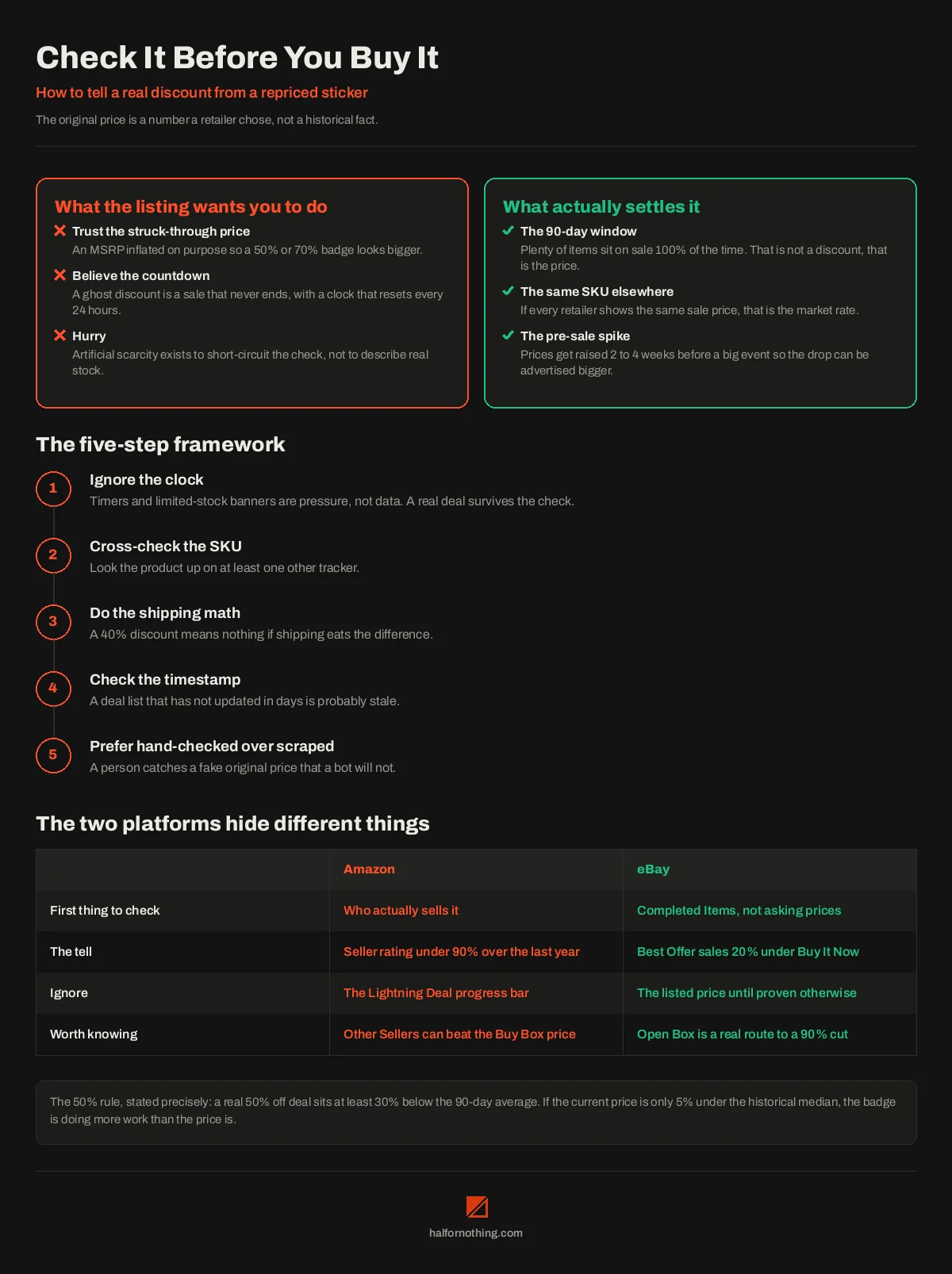
Most online price drops aren't actual discounts. They're a number set high on purpose so a lower number looks generous next to it. You've felt the pattern before: a price on Amazon or eBay that moves without warning, an “only 2 left” banner that's been there for a week, a strikethrough price that never seems to have been real. Telling a genuine clearance from an inflated starting point isn't hard once you know what to check, it's just not something most shopping sites want you to be able to do easily.
This is the checklist I actually use, the same one behind every 50%+ badge on Half or Nothing. I built it for myself first, honestly, I got burned by a fake “original price” on my own purchase before I ever thought about turning it into a filter for other people.
How do I know if a deal is actually legitimate?
A deal is legitimate when four things check out at once: the “original” price is verifiably real (it shows up in the item's own 90-day price history, not just on the listing itself), the seller has an identifiable track record, the return and warranty terms are stated plainly rather than buried, and the total landed cost (item plus shipping) is still below what the item has actually sold for elsewhere recently. If any one of those four is missing or vague, treat the discount as unproven until you check it, not as fake outright.
Key takeaways
Treat the “original price” as a number a retailer chose, not a fact. Real verification means checking it against price history, not trusting the label.
The only reliable check is the 90-day price history, not the current list price.
Amazon and eBay need different verification steps, because the platforms hide different things.
A five-step framework kills urgency and cross-checks the same item across sources before you buy.
Hourly refreshes and hand-checked Amazon picks are what keep the feed honest, not a one-time scrape.
In This Article
Why the “original” price can't be trusted on its own
A high “original price” changes how you judge everything under it, that's the whole point of putting one there. In e-commerce, that number is something a retailer set, not a historical fact. Manufacturer's Suggested Retail Price (MSRP) gets inflated all the time, specifically so a 50% or 70% badge looks bigger next to it. If the anchor is high, whatever price sits under it feels like a win, even when it isn't one.
Marketplaces actually track two different numbers here: a “List Price” (the highest figure a manufacturer suggests) and a “Typical Price” (the median over the last 90 days). A misleading listing leans on the List Price and ignores the Typical Price entirely, which is how you get a strike-through number with no real transaction history behind it.
How to spot an inflated price
Give it a 90-day window before you trust a discount. Plenty of items sit “on sale” 100% of the time, that's not a discount, that's just the price. Check the same product across a couple of independent retailers: if they all show the same “discounted” price, that's the actual market value, not a deal. And watch for a price spike right before a sale, retailers sometimes raise the number 2 to 4 weeks ahead of a big event specifically so they can advertise a bigger drop without actually lowering the real cost.
Ghost discounts
A ghost discount is a sale that never ends. It leans on “limited time” pressure with a countdown that quietly resets every 24 hours, code doing a job, not a reflection of real inventory. If a deal is always available, it isn't a deal, it's just the baseline price with a clock glued to it. A real drop means the current price is meaningfully below the 90-day median, not sitting right at it with a badge slapped on. This is exactly why there's no countdown timer anywhere on Half or Nothing, I don't want to sell you urgency, I want to show you the number.
The actual verification steps
You can't tell a real deal from a banner. It has to come from the numbers. For anything you're seriously considering:
Look up the price history. Paste the product URL into a price tracker and see where it's actually been.
Find the floor. What's the lowest this item has sold for in the last year?
Compare to the average. How far below the 1-year average is the current price, really?
Check stock. Confirm the item is actually available before you get excited about it.
Artificial scarcity is the main trick used to short-circuit this process, so the FTC's own guide to safe online shopping is worth reading once. A real deal survives the five minutes it takes to check it. If a listing is priced well below the real floor but comes from a third-party seller with zero history, that's a different risk calculation, not a reason to skip the check.
Six signals that separate a real deal from a staged one
Each of these is testable in under a minute, not a matter of opinion:
Original-price validation. The “was” price shows up in the item's own price-history chart at least once in the last 90 days. If it never appears there, it's an anchor the seller invented, exactly the pattern the FTC's Guides Against Deceptive Pricing prohibit.
Retailer identity. You can name who's actually selling it, the platform itself, a named third-party seller, or an established retailer, not an anonymous storefront with no history.
Seller reputation. A visible feedback score or rating history exists and isn't inherited from a different, unrelated product (a known trick on both Amazon and eBay).
Return policy stated plainly. A specific return window and process is listed on the page itself. “Final sale” or no policy at all on a big-ticket item is a real flag, not a formality.
Warranty or condition disclosed. For anything used, refurbished, or open-box, the condition grade and any remaining manufacturer warranty are stated, not implied.
Total landed cost, not sticker price. Shipping, taxes, and any restocking fee are added in before comparing to the item's actual recent sale price elsewhere. A 40% discount that adds $25 in shipping isn't 40% anymore.
Evidence of each failure mode is common enough to be worth naming directly: inflated list prices that never appear in real transaction history, listings with no stated return terms at all, seller accounts with a rating pulled from a different product category entirely, and “discounts” that quietly disappear once shipping is added at checkout. Any one of these on its own is a reason to slow down, not necessarily walk away.
Tools worth having
Browser extensions that overlay price history directly on Amazon and eBay listings are the fastest way to do this. Keepa is the one most people mean when they say this for Amazon. Something like this at scale is exactly what the hourly refresh on this site is doing behind the scenes, pulling items that don't clear the bar back out of the feed.
Reading a price chart
A sawtooth chart, regular spikes followed by an immediate “sale”, means the MSRP is decorative, not real. The floor (the lowest price in the last year) is your actual target: anything within 5% of it is a genuine deal. As a rule of thumb, I look for at least 15% below the 1-year average before a discount is worth the click.
Amazon and eBay need different checks
They hide different things, so the checklist isn't identical.
Amazon
“Sold by Amazon” means the platform itself owns the inventory. Third-party sellers on Amazon carry more pricing and risk variance. Check the seller rating, anything under 90% over the last year is worth a second look. Watch for review merging (a good rating inherited from a completely different product), and compare the “Coupon” checkbox against the “List Price” separately, stacking both sometimes gets you further than either alone. Ignore the “Lightning Deal” progress bar entirely, it's built to rush you, and check the price against the 90-day median instead. The “Other Sellers” section on a listing sometimes has a better price from a seller who just isn't paying for Buy Box placement.
eBay
Listed prices on eBay are aspirational until proven otherwise. Filter by “Completed Items” to see what people actually paid. Check the “Best Offer” history too, if an item consistently sells 20% under “Buy It Now,” the listed price is inflated. “Open Box” electronics are one of the best legitimate sources of a real 90% discount, usually new with damaged retail packaging. “Certified Refurbished” carries a manufacturer warranty, which is worth more than a plain “Used” listing at a similar price.
A 5-step framework I actually follow
Ignore the clock. Countdown timers and “limited stock” banners are pressure, not data. A real deal survives the time it takes to check it.
Cross-check the SKU. Look up the same product on at least one other tracker. If the price is the same everywhere, it's the market rate, not a special.
Do the real math on shipping. A 40% discount means nothing if shipping eats the difference.
Check the timestamp. A “deal” list that hasn't updated in days is probably stale.
Trust hand-checked over scraped. A person catches a fake “original price” or a canceled price-glitch order that a bot won't.
The 50% rule
If something's listed at 50% off, it's worth asking why: often the product is being phased out and the seller is clearing inventory ahead of a new SKU. A real 50% off deal sits at least 30% below the 90-day average. If the current price is only 5% under the historical median, that 50% badge is doing more work than the actual price is.
Here's what that actually looks like side by side: a real 55% off retinol serum right now, next to a similar serum at its normal price. Neither is fake, one's just a genuine markdown and the other isn't.
SkinMedica Retinol Complex 1.0 Anti-Aging Serum, 1 oz
Half or Nothing may earn commissions on qualifying purchases.
Curation catches what automation misses
An automated scraper working purely on volume will happily include expired or dead listings, it has no way to know better. That's how you end up clicking a “deal” that decayed hours ago. A person checking the feed catches that. High-frequency updates plus a real set of eyes is what actually prevents it, which is why the hourly refresh exists in the first place, every link active, every price checked against current Amazon and eBay data.
How Half or Nothing applies all of this
Half or Nothing is this checklist running as the actual filter for every listing on the site. No hype badges, no fake urgency, just the 50% line applied the same way every time. That line isn't negotiable for me, I'd rather post fewer deals than water down the one rule that makes this site worth your time.
Concretely, that means every listing on this site already passes the six-signal check above before it's published: the price is checked against real transaction history (not just the seller's own claimed original price), the retailer or seller is identifiable on the source listing, and nothing with a buried or missing return policy makes the cut. See how we verify every deal for the full methodology, and what actually counts as real 50% off for how the threshold itself is calculated.
Why hourly, and not daily
A deal that's real at 9am can be gone by 10am. A static list can't keep up with that, so the feed rebuilds every hour instead of once a day. Listings that don't clear the bar against the 365-day floor get pulled, no exceptions for a slow news day.
Amazon is the one part I still do by hand
Amazon's own affiliate API stopped working for accounts like mine (a flat 403 on every request), and the site actively blocks scrapers, so there's no honest way to automate this part. Every Amazon Pick on this site is something I personally checked and added, one at a time. It's slower, but it means I'm never showing you a number I can't stand behind.
Frequently asked questions
How can I tell if an Amazon original price is fake?
Check the 90-day price history. If the “original” price is higher than anything actually charged in the last three months, it's an inflated anchor. Amazon's own “Typical Price” label reflects the real 90-day median, if the discount is calculated off a List Price that hasn't been active recently, the savings aren't real.
What tools are best for tracking eBay price history?
Use eBay's own “Completed Items” filter to see actual realized sale prices, that's the most reliable source since it's the platform's own transaction data. External SKU trackers can add historical trend lines on top of that. Avoid anything that only shows the current listing price with no history behind it.
Is a 50% discount always a real deal?
No. It's only real if the starting price actually matches the 90-day median. Plenty of retailers raise the price right before a sale specifically to manufacture a bigger percentage drop. I look for at least 30% below the 1-year average before I trust a 50% badge.
Why do prices sometimes change when I click through?
Because pricing on Amazon and eBay moves in real time, and any aggregator (including this one) can lag behind that by a few minutes between refreshes. That's exactly why Half or Nothing refreshes hourly instead of daily, to keep that gap as small as it can be.
What's the difference between an aggregator and a coupon site?
An aggregator filters real, live marketplace listings for actual price drops. A coupon site hands out codes that frequently fail at checkout. I don't run a generic coupon database, on eBay the discount is always already baked into the listing price, and on Amazon, when a real coupon exists, I find it, verify it, and add it myself instead of pulling it from a scraped feed.
How does Half or Nothing actually verify its deals?
Every listing is hand-picked from real Amazon and eBay inventory, the feed refreshes hourly to drop anything expired or repriced, and nothing with an inflated MSRP or a sketchy seller rating makes the cut.
Can I trust “Open Box” deals on eBay for electronics?
Usually, yes, once you check the seller's return policy. “Open Box” is often a genuine 90% discount caused by damaged retail packaging, not a damaged product. “Certified Refurbished” goes a step further with a manufacturer warranty attached, which is worth more than a plain “Used” listing at a similar price.
What should I do if I find a price discrepancy on a deal site?
Assume it's a timing gap, not a scam. If the marketplace price is higher than what a deal site shows, the discount has probably already expired since your last refresh. Don't buy off the stale number, check the timestamp and confirm the live price first.
How to verify a jewelry discount is real, what return and authenticity terms actually protect you, and when outlet, resale, and marketplace pricing is genuine versus repackaged markup.