France fined one retailer 40 million euros after finding that 57% of its advertised discounts offered no price cut at all. The United States has had a law against the same practice since 1967 and largely stopped enforcing it more than fifty years ago. This page collects every figure we could trace back to the body that produced it.
Each statistic below names its source, the date it was published and a link to the original. Where a regulator or researcher published an exact quote, we use theirs rather than paraphrasing.
Key Takeaways
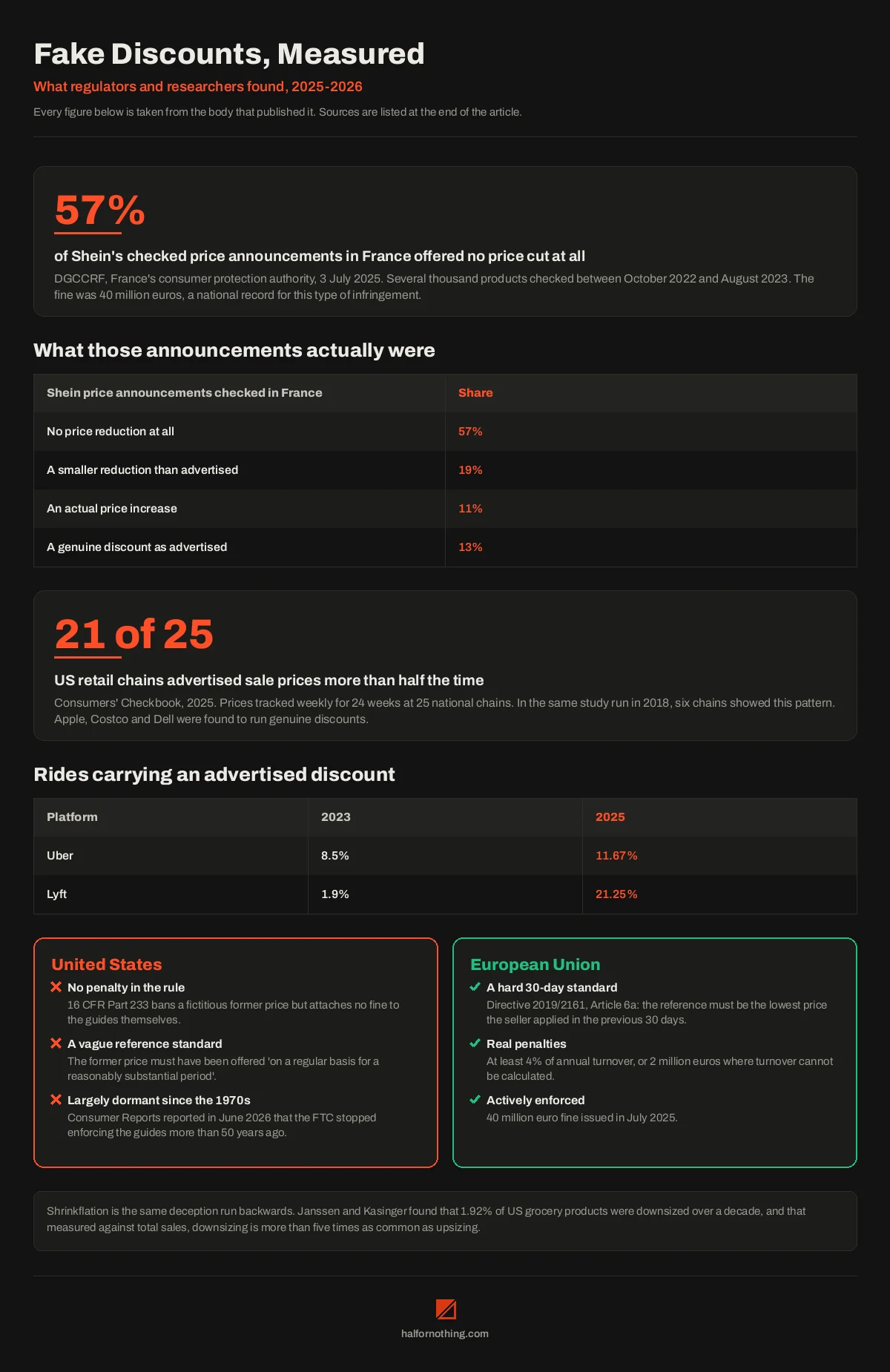
57% of Shein's advertised price reductions in France offered no price cut at all, according to the DGCCRF, the French consumer protection authority (July 2025).
11% of those advertised "discounts" were actually price increases (DGCCRF, July 2025).
Shein was fined 40,000,000 euros, a record in France for this type of infringement (DGCCRF, July 2025).
21 of 25 national retail chains advertised sale prices more than half the time across a 24-week study (Consumers' Checkbook, 2025).
The number of chains doing this rose from 6 in 2018 to 21 in 2025 (Consumers' Checkbook).
12.4% of all discounts advertised by Uber and Lyft were fake, based on inflated original prices (Consumer Reports, June 2026).
Nearly 50% of Uber and Lyft prices were presented as carrying some kind of discount (Consumer Reports, June 2026).
EU law requires an advertised price reduction to reference the lowest price applied in the previous 30 days (Directive 2019/2161, Article 6a).
EU fines can reach 4% of a trader's annual turnover, or at least 2 million euros where turnover cannot be calculated (Directive 2019/2161).
The US rule against fictitious pricing dates from 8 November 1967 and has not been substantively amended since (16 CFR Part 233).
Product downsizing is more than five times as common as upsizing, and typically happens without a matching price cut (Marketing Science, 2025).
Shoppers react more to price changes than to size changes, which is why shrinkflation works (Marketing Science, 2025).
In This Article
How common are fake discounts?
The most thorough public measurement comes from Consumers' Checkbook, a nonprofit consumer research group. Its researchers started in February 2025. They checked prices at 25 national chains once a week for 24 weeks, covering 25 or more items at each store.
The result: 21 of the 25 chains advertised sale prices more than half the time. For 12 of the 25 companies, more than half the tracked items were offered at a false discount every week or almost every week. Across the chains that failed, roughly 76% of tracked items carried a sale label.
Checkbook has run the same study before, so there is a trend line rather than a snapshot. In 2018 six chains showed this pattern. By 2025 it was 21.
We have hit the limits of this kind of measurement ourselves. Our own price history can show a pattern without proving what caused it, which is the subject of what our price tracking actually proves.
Study year
Chains advertising near-permanent discounts
2018
6
2025
21
Three chains came out of the 2025 study with discounts the researchers considered legitimate: Apple, Costco and Dell.
What did regulators actually find?
France's consumer protection authority, the DGCCRF, published its findings on 3 July 2025. The target was Infinite Style E-commerce LTD, the entity responsible for Shein's sales. Investigators recorded three things for several thousand products on the French site: the selling price, the struck-through price and the advertised discount. The window ran from 1 October 2022 to 31 August 2023.
The published finding, in the DGCCRF's own words:
"57 % des annonces vérifiées par le SNE de la DGCCRF n'offraient aucune baisse de prix, 19 % une baisse moins importante qu'annoncée et 11 % étaient en réalité des augmentations de prix."
Translated: 57% of the verified announcements offered no price reduction, 19% offered a smaller reduction than advertised, and 11% were actually price increases.
What the "discount" really was
Share of announcements
No price reduction at all
57%
Smaller reduction than advertised
19%
An actual price increase
11%
A genuine discount as advertised
13%
The fine was 40 million euros. The DGCCRF called it a record in France for deceptive commercial practices of this kind.
What the regulator is measuring here is the reference price, the "before" number a discount is calculated against. That is the same number we had to pin down before we could claim a percentage of our own, explained in what counts as a real 50% discount.
Is this only a retail problem?
No. The most recent measurement comes from ride-hailing. Consumer Reports published a months-long investigation on 16 June 2026. In it, 174 volunteers priced more than 40 routes across 18 states during March and April 2026. Prices were captured within six minutes of each other, and often within the same minute.
Their findings:
12.4% of all advertised discounts appeared to be fake, based on inflated original prices.
Nearly 50% of up-front prices were presented as reflecting some kind of discount or saving.
The median difference between the highest and lowest price groupings on the same route was 42.4%.
On one Kansas City route, 55 potential riders saw 29 different prices for the same trip.
On an Atlanta route, 37 volunteers priced the same ride at exactly 8:26 pm and final prices ranged from $2.28 to $14.99.
Discounting there is structural, not occasional. A University of Nevada, Las Vegas research team analysed roughly 20 million rides. The share carrying an explicit advertised discount grew sharply in two years.
Platform
Rides with an advertised discount, 2023
2025
Uber
8.5%
11.67%
Lyft
1.9%
21.25%
What does the law actually say?
Two jurisdictions, two very different postures.
The European Union
Directive (EU) 2019/2161 inserted Article 6a into the earlier price indication directive. The text is short and specific:
"Any announcement of a price reduction shall indicate the prior price applied by the trader for a determined period of time prior to the application of the price reduction. The prior price means the lowest price applied by the trader during a period of time not shorter than 30 days prior to the application of the price reduction."
The directive also sets the penalty floor. Member states must set a maximum fine of at least 4% of the trader's annual turnover in the member states concerned. Where turnover information is unavailable, the maximum must be at least 2 million euros.
The practical effect of that rule is a price history. A seller cannot claim a reduction it has not held a low price against for 30 days. Keeping that history is why our own listings are rechecked every hour.
The United States
The equivalent American rule is 16 CFR Part 233, "Guides Against Deceptive Pricing", published at 32 FR 15534 on 8 November 1967. The eCFR records no changes to this content after 3 January 2017.
Its definition of a fictitious former price is unambiguous:
"If the former price being advertised is not bona fide but fictitious, for example, where an artificial, inflated price was established for the purpose of enabling the subsequent offer of a large reduction, the 'bargain' being advertised is a false one; the purchaser is not receiving the unusual value he expects."
The rule then walks through the mechanic with a worked example. A retailer buys pens for $5 and normally sells them at $7.50. He raises the price to $10 for a few days, knowing he will sell almost none, then "cuts" it back to $7.50 and advertises "Terrific Bargain: X Pens, Were $10, Now Only $7.50!". The regulation's verdict: "This is obviously a false claim."
The gap is not in the law. Consumer Reports noted in June 2026 that the Federal Trade Commission "largely stopped enforcing those guidelines more than 50 years ago".
United States
European Union
Rule
16 CFR 233 (1967)
Directive 2019/2161, Article 6a
Reference price standard
Offered "on a regular basis for a reasonably substantial period"
Lowest price in the previous 30 days
Maximum penalty
No fine attached to the guides themselves
4% of annual turnover, or at least 2 million euros
Recent enforcement
Largely dormant since the 1970s
40 million euro fine, July 2025
What about shrinkflation?
Shrinkflation is the same deception approached from the opposite direction. Instead of inflating the old price, the product gets smaller while the price holds.
Aljoscha Janssen and Johannes Kasinger analysed a decade of US retail scanner data in "Shrinkflation and Consumer Demand", published in Marketing Science in January 2026. They found that 1.92% of products had been downsized. Measured against total sales, downsizing is more than five times as common as upsizing. Size reductions typically arrive without a matching price cut, so the shopper pays more per unit.
The study also explains why the tactic survives. In the authors' words:
"Consumers are more responsive to price adjustments than to changes in product size."
People watch the price. They do not watch the package.
Both tricks fail the same test, which is whether the comparison is real. The checks we run before a listing goes up are in how to verify a real online deal.
Frequently Asked Questions
What is a fake discount?
A fake discount, known in regulation as false reference pricing or a fictitious discount, is an advertised price reduction measured against a price the seller never genuinely charged. The US rule (16 CFR 233) describes it as an "artificial, inflated price established for the purpose of enabling the subsequent offer of a large reduction".
Is advertising a fake discount illegal?
In the European Union, yes, and it carries fines of up to 4% of annual turnover under Directive 2019/2161. In the United States the practice is covered by 16 CFR Part 233, in force since 1967. Consumer Reports reported in June 2026 that the FTC has largely not enforced those guides for more than fifty years. Several US states, including California, have their own reference pricing laws that private plaintiffs have used.
What is the 30-day rule?
Under EU law, any advertised price reduction must be calculated against the lowest price the trader applied during at least the 30 days before the promotion started. The rule comes from Article 6a of Directive 2019/2161. There are exceptions for perishable goods and for products that have been on the market for less than 30 days.
How many advertised sales are actually fake?
It depends on the sector and who measured it. Consumers' Checkbook found that 21 of 25 US retail chains advertised sale prices more than half the time in 2025. The DGCCRF found that 57% of the Shein announcements it checked in France carried no real price cut. Consumer Reports found 12.4% of Uber and Lyft discounts were based on inflated original prices.
Which retailers ran legitimate sales?
In the 2025 Consumers' Checkbook study, three chains were found to run discounts the researchers considered genuine: Apple, Costco and Dell.
Aljoscha Janssen and Johannes Kasinger, "Shrinkflation and Consumer Demand", Marketing Science, vol. 45 no. 1, pages 142-158, January 2026. Paywalled at the publisher; the full citation is given here so the paper can be requested through a library.
How to verify a jewelry discount is real, what return and authenticity terms actually protect you, and when outlet, resale, and marketplace pricing is genuine versus repackaged markup.
Ferragamo, Bruno Magli, Hugo Boss, Isaia, and Saint Laurent dress shoes at 51-73% off. Real listings, real leather, real half-off prices on Half or Nothing.
A Ralph Lauren edit from what is live on Half or Nothing now: navy and grey tailoring, metallic gowns, velvet, and the Polo and Romance fragrances, at half off or better.