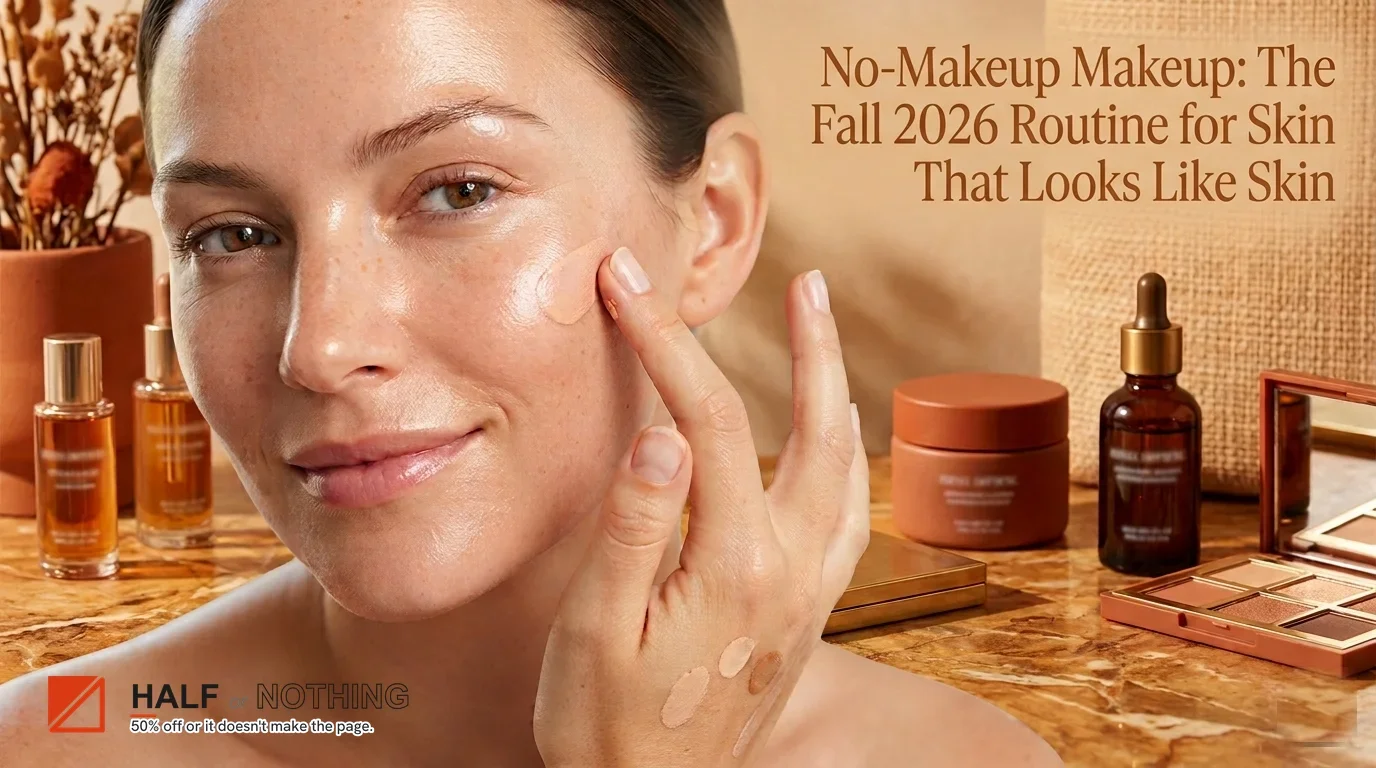
No-Makeup Makeup: The Fall 2026 Routine for Skin That Looks Like Skin
No-makeup makeup for fall 2026 is skin that looks like skin. Here is the skincare-first routine and the four makeup steps, with the deals we verified.
2026-09-06
Half or Nothing
50% off or it doesn't make the page.
2026-09-02 · Written by Dann Nazario · 13 min read
Every year, millions of us love treating ourselves to high-end anti-aging creams. There is nothing quite like the premium feel of a luxury product that delivers real results. Still, looking at that price tag makes you wonder: does a higher retail price always mean fewer wrinkles?
According to the Mayo Clinic, a higher price tag does not automatically mean a wrinkle cream works better. High-end products often share the same proven active ingredients as simpler formulas. A big part of what you pay for at full retail is the marketing, the celebrity faces in the ads, and the heavy, beautiful glass jars.
Speaking of those jars, there is one technical detail brands rarely highlight. Wide-mouth pots that expose the product to air and light every morning can cause active ingredients like retinol and vitamin C to break down faster. Mayo's own advice for delicate actives like vitamin C is to keep them somewhere cool and dark, closing them tightly after each use to protect the formula's potency.
Here is the short version. Wear broad-spectrum sunscreen every day. Use a retinoid at night. Give it months, not days. That is the core routine dermatologists recommend, and you do not need a luxury budget to start seeing real results.
At Half or Nothing we love these high-end formulas, and we hate paying full price for marketing. This guide covers what causes fine lines, the three ingredients with real scientific evidence, a four-step morning routine and five-step evening routine, and how long results actually take.
We have included the top high-end names here because their formulas are excellent, but we are not linking them at full retail price. We track department store clearances and liquidations for these exact luxury favorites. As soon as one hits our 50 percent bar, we add the discount link so you can get premium skincare for half the cost.
In This Article
Wrinkles come from several causes at once, some within your control and some not.
Age is the baseline. As Mayo Clinic puts it, "with aging, the skin naturally becomes less elastic and drier, with less fat and collagen in the deeper layers." In numbers, the fibroblasts that build skin structure make roughly 1 percent less collagen and elastin each year from your mid to late twenties, and older fibroblasts also produce more of the enzymes that break collagen down.
The sun does the rest, and more of it than most people expect. Ultraviolet light speeds aging and breaks down the elastin and collagen that keep skin firm. UVA reaches the deep dermis and drives collagen loss directly. At the cell level, UV floods the skin with reactive oxygen species and switches on inflammatory signaling. That raises matrix metalloproteinases, the enzymes that degrade collagen and elastin.
Repeated expressions add the rest of the map. "Every time you squint, smile and frown, tiny grooves form beneath the surface of the skin," and as skin loses flexibility those grooves stay. Smoking, pollution, and the genes you inherit fill in the picture.
One cause stands well above the others. The sun accounts for up to 90 percent of visible skin changes, and current reviews describe this kind of aging as largely preventable.
Three ingredients carry most of the evidence: sunscreen, retinoids, and vitamin C. A 2025 consensus of cosmetic dermatologists placed all three at the top for fine lines.
Sunscreen is the most reliable anti-aging step, ahead of any cream. Use a broad-spectrum SPF 30 or higher every day of the year, reapply every two hours outdoors, and know that sun through a window still ages skin. Apply it as the last step before makeup.
A lightweight broad-spectrum SPF 50 that also works as a makeup base. Code SVNCOTCU at checkout.
Retinoids and retinol are vitamin A derivatives that smooth wrinkles and even out tone. Retinol is the milder over-the-counter form. A 2025 meta-analysis of eight randomized trials found prescription tretinoin improved both fine and coarse wrinkles, with a bigger effect on fine wrinkles, consistently enough across all eight trials to be statistically clear (p < 0.001). Over-the-counter products use lower concentrations, so they work less strongly and results last less long. Retinol can irritate at first, which usually settles over a few weeks. Adapalene, sold over the counter as Differin, is another option. Retinoids are not used during pregnancy, and bakuchiol is a gentler alternative that is considered pregnancy-safe.
A ceramide cleansing oil, 60 retinol and HPR capsules, and a retinol and HPR water cream. A retinoid, peptides, and niacinamide in one starter set.
Vitamin C, used daily, helps protect skin from sun and pollution damage and can improve tone. In controlled trials, vitamin C-treated skin looked smoother and less wrinkled than untreated skin, with the benefit building over months. Look for L-ascorbic acid on the label, and pair it with vitamin E. Store it somewhere cool and dark, since it breaks down in light and air.
A lightweight, fragrance-free vitamin C serum, and proof that this ingredient does not need a luxury price. Code 5TXLOQ79 at checkout.
Peptides signal the skin to make more collagen. Recent studies show measurable wrinkle improvement over four to eight weeks. The evidence is still thinner than for retinoids, so peptides work best as an add-on rather than a replacement.
An ampoule, a moisturizer, and hydrogel eye patches built around centella and PDRN, a newer firming ingredient with less long-term data than retinoids.
Niacinamide, a form of vitamin B3, may reduce signs of aging and improve tone, and it calms skin so other actives are easier to tolerate.
Moisturizer and hyaluronic acid temporarily plump the skin so lines look less visible. They do not prevent or remove wrinkles, but they make the rest of a routine more comfortable to use.
A leave-on night mask with pro-retinol, hyaluronic acid, and vitamin C, a low-effort way to get retinol and hydration in one step.
Wrinkle creams are regulated as cosmetics, not medicine, so they are not tested the way prescription treatments are. As Mayo Clinic puts it, "there's no guarantee they will reduce wrinkles." A luxury formula can still be a genuinely good product. It just helps to know what any cream, at any price, can realistically do:
The skin around the eyes is thinner and tends to show lines first, so a dedicated eye product can be gentler there, though a careful application of your regular serum does the same job. For the neck and chest, the simplest move is to bring your retinoid and your sunscreen down past the jaw. Those areas get the same sun as the face and are often left out. The firming set above includes hydrogel eye patches if you want a dedicated step.
Give any product at least six weeks, and up to three months, of regular use before deciding it works. Mayo Clinic is blunt that you "may see no change at all." Add one active at a time so you can tell what is helping and avoid piling on irritation. Retinoids and vitamin C both take months, not days. For results beyond what a cream can do, see a dermatologist. Prescription retinoids, chemical peels, microneedling, laser, and injectables all reach deeper than a topical.
At-home LED masks have some clinical support and several are cleared by the FDA, though the consumer evidence is limited and results are gradual. At-home microcurrent devices give a real lift that fades within a day or two without regular use. Neither replaces sunscreen and a retinoid. In a 2025 split-face trial, microneedling paired with a vitamin C, E, and ferulic acid serum improved photoaging over 12 weeks.
A cordless LED mask for home use, with eye protection.
| Step | Product | Status | Price |
|---|---|---|---|
| SPF, AM | Clevariel Tone-Up Sunscreen SPF 50 | Deal, 60% off | $7.99 (was $19.99) |
| Vitamin C, AM | Pore Refining Serum, Green Tomato & Vitamin C | Deal, 50% off | $4.95 (was $9.89) |
| Retinoid starter, PM | Elizabeth Arden Smooth, Repair & Firm 3-Piece Set | Deal, 50% off | $49.50 (was $99.00) |
| Peptides and firming, PM | CENTELLIAN 24 PDRN Firming Set | Deal, 58% off | $45.05 (was $106.00) |
| Overnight mask | L'Oreal Revitalift Triple Power Overnight Mask | Deal, 50% off | $14.99 (was $29.99) |
| Device | Red Light Therapy Mask, 400 LEDs | Deal, 60% off | $49.99 (was $124.99) |
| Vitamin C, prestige | SkinCeuticals C E Ferulic | On the watch list | Full price |
| Retinoid, prestige | Dr. Dennis Gross Advanced Retinol + Ferulic Serum | On the watch list | Full price |
| Night serum | Estee Lauder Advanced Night Repair | On the watch list | Full price |
| Rich cream | Augustinus Bader The Rich Cream | On the watch list | Full price |
| Moisturizer | Creme de la Mer | On the watch list | Full price |
| Overnight mask, hyped | Biodance Bio-Collagen Real Deep Mask | On the watch list | Regular price |
| LED mask | Omnilux Contour Face | On the watch list | Full price |
| Microcurrent | NuFACE Trinity+ | On the watch list | Full price |
6 verified deals in this post.
These are the high-end names people ask us about most. None is at our 50 percent bar right now, so each link goes to the product at full price. We track clearances and price drops on these and will swap in a deal link the moment one qualifies, so save the page if you have your eye on one.
SkinCeuticals C E Ferulic Still full price as far as we can tell. The link below goes straight to the regular listing until that changes. The vitamin C serum dermatologists cite most, with vitamin E and ferulic acid.
Dr. Dennis Gross Advanced Retinol + Ferulic Serum Nothing at 50% off on this one yet, so you're looking at the full-price page for now. A stabilized retinol paired with ferulic acid for a gentler ramp than prescription strength.
Estee Lauder Advanced Night Repair We haven't caught a real discount on this one. Full price until we do. A long-studied night serum with hyaluronic acid.
Augustinus Bader The Rich Cream This one hasn't hit our bar yet, so the link just goes to the regular product page. A rich night cream, one of the few luxury creams with a published clinical study.
Creme de la Mer No qualifying deal on this one so far. It's a full-price link below. The most-searched luxury moisturizer, rich and comforting, built around the brand's Miracle Broth.
Biodance Bio-Collagen Real Deep Mask No deal yet. This one sits at its regular price, about $19 for four, so the link goes straight to the product. An overnight hydrogel mask for a plumper look the next morning.
Omnilux Contour Face Still waiting on a real markdown here. The link goes to the full-price listing in the meantime. An FDA-cleared LED mask with the most peer-reviewed clinical data.
NuFACE Trinity+ No 50%-off deal found for this one yet, so it links to the regular product page for now. The best-known at-home microcurrent device. Effects are visible and build with regular use.
There is no strict start date. Skin makes roughly 1 percent less collagen each year from the mid to late twenties, so the mid-20s to early 30s is a reasonable time to lock in daily sunscreen and, if you want, add a retinol and a vitamin C serum. Daily broad-spectrum sunscreen is the step that matters at any age.
The strongest recent evidence is for retinoids and topical vitamin C, with daily sunscreen as the base. A 2025 meta-analysis of randomized trials found prescription tretinoin reduced both fine and coarse wrinkles across all eight trials studied (p < 0.001), and Mayo Clinic lists retinol, vitamin C, and niacinamide as the ingredients most likely to help. Peptides can support firmness and texture as an add-on. Hyaluronic acid plumps the look of lines temporarily without changing the wrinkle.
Daily broad-spectrum sunscreen, SPF 30 or higher, every day of the year, including cloudy days and time near windows. The sun accounts for up to 90 percent of visible skin aging, and current reviews describe photoaging as largely preventable. Not smoking matters too.
No. Lasers, microneedling, peels, biostimulators, and injectables can soften visible lines, improve texture, and restore some firmness, but they do not stop the underlying process. They work alongside daily sun protection and a topical routine, not instead of them.
The two biggest modifiable factors are sun exposure and smoking. Sleep, a diet with enough protein and antioxidants, and managing stress are supported as contributors, because the oxidative and inflammatory pathways that age skin respond to all of them. Claims that a specific type of exercise reverses skin aging are not established.
Half or Nothing may earn commissions on qualifying purchases made through the deal links above. Watch-list links are provided for reference and are not verified deals. This article is general information and not medical advice. A board-certified dermatologist can tailor a plan to your skin. See our affiliate disclosure.
For more skincare deals as they land, see beauty and skincare on Half or Nothing.
Every pick we've pulled at 50% off or more, in one place.
Visit our Amazon store ›No-makeup makeup for fall 2026 is skin that looks like skin. Here is the skincare-first routine and the four makeup steps, with the deals we verified.
2026-09-06
How to tell if your skin is oily, dry, or combination, plus a simple routine and the best products for each type, with real deals checked at 50% off or more.
2026-09-01
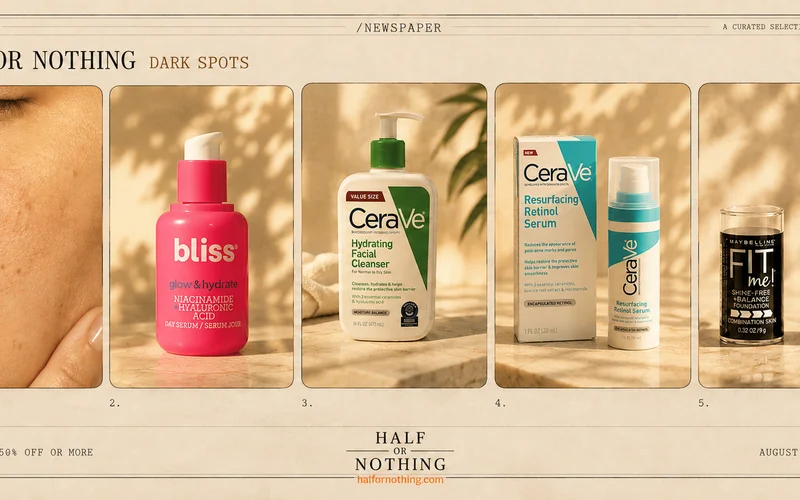
Dark spots from acne, sun, or irritation take time to fade. Here is a simple skin care and makeup routine, plus the deals to build it on Half or Nothing.
2026-08-27